She Told a Navy Officer to Remove Her Uniform—Then Security Arrived
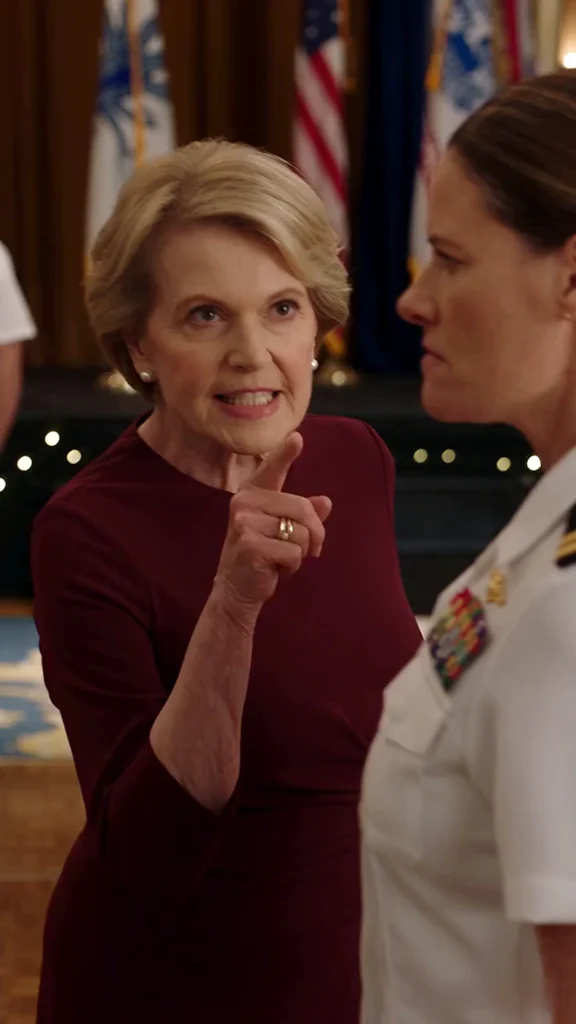
She Told a Navy Officer to Remove Her Uniform—Then Security Arrived and Everything Changed
Helen Mercer had no idea how quickly her confidence would turn against her.
“If everything is in order, there should be no problem,” she repeated, turning toward the security officer near the ballroom entrance.
Frank Mercer stepped in front of her.
“Mom, stop. You have embarrassed yourself enough.”
But Helen was no longer listening. She had spent too much of her life believing that confidence could substitute for knowledge. If someone challenged her assumptions, she treated it as a personal insult. If someone refused to agree with her, she assumed they were hiding something.
And Sarah Mitchell, standing calmly in her white Navy uniform, had become the center of everything Helen refused to understand.
The security officer approached, accompanied by the event coordinator. Conversations faded as guests began watching openly.
“Is there a problem here?” the officer asked.
Helen immediately answered.
“Yes. I believe this woman is misrepresenting herself as a Navy officer. I would like someone to verify her credentials before this ceremony continues.”
A wave of discomfort moved through the guests.
Sarah did not interrupt.
Instead, she looked directly at the security officer and spoke in an even voice.
“Of course. Please follow the appropriate verification procedure.”
Her response caught Helen off guard.
She had expected anger, excuses, or an attempt to leave. Sarah offered none of those things. She simply stood where she was, composed and unafraid.
The event coordinator glanced at Sarah’s uniform, then at the officer beside him.
“Ma’am,” he said respectfully, “may I see your identification?”
Sarah nodded and presented her military identification.
The officer examined it carefully. His expression changed almost immediately.
He looked at Sarah again, this time with unmistakable recognition.
“Commander Mitchell,” he said, straightening slightly. “I’m sorry for the interruption.”
The words carried across the nearest tables.
Helen blinked.
“Commander?”
The security officer returned Sarah’s identification with both hands.
“Everything checks out, ma’am. Your credentials are in order.”
Helen gave a nervous laugh.
“Well, that’s good. Then perhaps we can all move on.”
But the officer did not immediately step away.
“Mrs. Mercer, the issue wasn’t whether the verification process could be completed. It was the accusation you made publicly before knowing the facts.”
Helen’s smile disappeared.
Sarah gently intervened.
“Thank you. I appreciate you doing your job.”
The officer nodded and stepped back, leaving the silence behind him.
For the first time that evening, Helen seemed unable to find the right words.
She had demanded proof, convinced that the truth would expose Sarah. Instead, the truth had exposed how little Helen actually knew.
The Recognition That Changed the Room
A senior Navy officer standing near the platform had witnessed the exchange. He approached Sarah with a respectful nod.
“Commander Mitchell, I wasn’t expecting to see you here until the program began.”
“Good evening, sir,” Sarah replied. “The schedule changed slightly.”
The officer smiled.
“I’m glad you made it. The team has been looking forward to your remarks.”
Helen turned toward him.
“Your remarks?”
He looked at her, then back at Sarah.
“Yes. Commander Mitchell has been asked to speak about leadership, service, and the importance of supporting the people who serve alongside us.”
The realization moved through the surrounding guests in a quiet wave.
Sarah was not an outsider who had somehow wandered into an important gathering. She was a recognized officer whose presence was part of the evening’s program.
The young lieutenant who had noticed the confrontation earlier returned to the group. He greeted Sarah with a respectful acknowledgment before continuing toward the platform.
Helen watched him go.
She had seen the same uniform, the same decorations, and the same composure everyone else had seen. The difference was that she had decided what they meant before bothering to understand them.
Frank looked at his mother.
“Are you beginning to understand why I asked you to stop?”
Helen’s face tightened.
“I was only trying to protect the integrity of the event.”
“No,” Frank replied. “You were trying to prove that you knew more than everyone else.”
“That is unfair.”
“What was unfair was telling my wife to take off her uniform in front of a room full of people.”
Helen glanced around. Several guests quickly looked away, but their silence no longer offered her the protection it once had.
Sarah could have used the moment to humiliate her. She could have listed her achievements, demanded an apology, or reminded everyone that Helen had been wrong.
Instead, she remained quiet.
Her restraint made the situation even more difficult for Helen to dismiss.
Sarah’s Unexpected Response
The event coordinator approached Sarah and quietly asked whether she wanted the program delayed.
“No,” Sarah answered. “The ceremony should continue as planned.”
She then turned toward Helen.
“Mrs. Mercer, I understand that you may have questions about my service. There are appropriate ways to ask them. Public accusations are not one of those ways.”
Helen crossed her arms.
“So you’re saying I have no right to question anything?”
“I’m saying that asking a question and declaring someone a fraud are two different things.”
Sarah’s voice remained calm.
“You don’t have to understand every detail of my career. But you should be willing to learn before deciding that someone has done something wrong.”
For several seconds, Helen said nothing.
The words were not delivered as a threat. They were not even particularly harsh. That made them harder to argue against.
Frank moved beside his wife.
“She has shown you more respect tonight than you have shown her.”
Helen turned toward him, wounded by the fact that he had chosen Sarah’s side so openly.
“I am your mother.”
“And Sarah is my wife,” he answered. “Both things matter. But being my mother doesn’t give you permission to disrespect the person I love.”
The sentence landed more heavily than any accusation in the ballroom.
Helen had expected her son to defend her automatically. She had mistaken family loyalty for unconditional agreement.
Frank was not abandoning her. He was asking her to take responsibility for her behavior.
That distinction was one she had never learned to accept.
The Story Behind Sarah’s Uniform
As the ceremony resumed, guests gradually returned to their seats. The band began playing softly, and the event coordinator directed everyone toward the platform.
Sarah paused beside a table near the back of the room.
For the first time that evening, her expression softened.
Frank noticed.
“Are you all right?” he asked.
“I’m fine.”
“You shouldn’t have had to deal with any of that.”
Sarah considered his words.
“It’s not the first time someone has made assumptions about me.”
Frank frowned.
“Does that make it easier?”
“No,” she admitted. “It just teaches you that you can’t control what other people believe. You can only control how you respond.”
She had spent years earning the responsibilities represented by her uniform. There had been demanding assignments, difficult decisions, long stretches away from home, and moments when the right choice was far from the easiest one.
None of that could be understood from a glance across a ballroom.
Sarah had never expected strangers to know her entire story. She had simply hoped they would show enough humility to avoid pretending they already knew it.
Frank took her hand.
“I should have stepped in sooner.”
“You stepped in when it mattered.”
“I let her get too far.”
Sarah squeezed his hand gently.
“Then remember this the next time. You don’t have to wait for someone to be completely humiliated before you stand beside them.”
Frank nodded. He understood that the conversation was about more than one uncomfortable evening. It was about the boundaries their marriage needed and the respect that should exist within their family.
Across the room, Helen watched them together.
For the first time, she seemed to recognize that Frank’s defense of Sarah was not a passing disagreement. It was a statement about the kind of husband he intended to be.
A Ceremony Helen Would Never Forget
When the master of ceremonies introduced Sarah, the ballroom fell quiet once again.
She walked toward the platform with measured steps. The same people who had witnessed Helen’s accusation now watched her with a different kind of attention.
Sarah began her remarks by thanking the organizers and acknowledging the people whose service and dedication made the evening possible.
She spoke about leadership without making it sound glamorous.
“Leadership,” she said, “is not about being the loudest person in a room. It is about accepting responsibility when it would be easier to look away.”
Several guests exchanged glances.
Sarah continued.
“It is about recognizing that every person has a story you may not know. A uniform, a title, or a position can tell you something about someone’s responsibilities. It cannot tell you everything about their character.”
Her words were measured, and she never looked toward Helen.
“Respect does not require us to agree with everyone. It requires us to treat people fairly, especially when we do not understand their experiences. And when we discover that we were wrong, integrity means having the courage to admit it.”
The room responded with warm applause.
Frank stood first. Others soon joined him, and the applause spread across the ballroom.
Helen remained seated for a moment.
She had expected Sarah to use the platform as an opportunity for revenge. Instead, Sarah had spoken about principles that applied to everyone, including the person who had insulted her.
That made the lesson impossible to dismiss as a personal attack.
Helen eventually stood with the others, clapping quietly.
But Sarah did not look for her reaction. She accepted the acknowledgment, thanked the audience, and stepped down from the platform.
She had nothing to prove to Helen.
The Apology That Came Too Late to Erase the Hurt
Later in the evening, Helen found Sarah near the ballroom’s side entrance.
Frank was standing a short distance away, speaking with another guest. Helen approached slowly, her earlier certainty replaced by visible discomfort.
“Sarah?”
Sarah turned.
“Yes?”
Helen glanced toward the crowded ballroom before speaking.
“I think there has been a misunderstanding.”
Sarah waited.
Helen had intended to offer an explanation. She wanted to say that she had been concerned, that she had acted for the sake of the event, and that everything had happened too quickly.
But each explanation sounded weaker the longer she considered it.
Finally, she said, “I shouldn’t have spoken to you that way.”
It was not a perfect apology. It did not fully acknowledge the embarrassment she had caused or the assumptions that had driven her behavior.
Still, it was the first honest sentence she had offered Sarah all evening.
“No,” Sarah replied gently. “You shouldn’t have.”
Helen looked down.
“I thought I was protecting my family.”
“Protecting your family doesn’t mean deciding who deserves respect before you know them.”
Helen swallowed.
“I understand that now.”
Sarah studied her for a moment.
“Then I hope you’ll remember it.”
Helen hesitated.
“Can we put this behind us?”
“We can move forward,” Sarah said. “But moving forward doesn’t mean pretending it didn’t happen. Trust takes time.”
Helen nodded slowly.
She had wanted a quick resolution, one that would restore the evening and return everything to the way it had been before she spoke.
But an apology was not a button that erased consequences. It was the beginning of a responsibility to behave differently.
Frank joined them a moment later.
His mother looked at him.
“I owe you an apology too.”
Frank’s expression softened, although he did not immediately answer.
“I don’t want you and Sarah to feel that you have to choose between me and your family,” Helen continued. “I know I made that difficult tonight.”
“You did,” Frank said honestly.
Helen nodded.
“I am sorry.”
Frank accepted the apology, but he did not pretend that one conversation had repaired everything.
“Then let’s do better from here,” he said.
For the first time that evening, the three of them stood together without anyone trying to win an argument.
It was not a perfect ending. It was something more realistic: a chance to begin again.
What Helen Finally Learned
As guests began leaving the ballroom, Helen remained near the entrance for a few moments.
She watched Sarah greet colleagues, accept congratulations, and speak with people who clearly respected her.
Nothing about Sarah had changed during the evening. Her rank had not changed. Her experience had not changed. Her character had not changed.
Only Helen’s understanding had been challenged.
The uniform Helen had dismissed now represented years of commitment she had never bothered to consider. The quiet woman she had mistaken for an impostor had demonstrated more dignity than Helen had shown throughout their confrontation.
Helen finally understood the mistake at the center of it all.
She had believed that authority belonged to whoever spoke with the greatest confidence. She had confused judgment with wisdom and public correction with genuine concern.
But confidence could be misplaced. And a person could speak loudly, firmly, and repeatedly while still being completely wrong.
Sarah had not won because security verified her identity. She had not won because a senior officer recognized her or because the room applauded her speech.
She had won the moment she refused to let someone else’s arrogance determine her own behavior.
That was the part Helen would remember long after the evening ended.
When Frank and Sarah prepared to leave, Helen approached them one final time.
“Good night,” she said. Then, turning to Sarah, she added, “And thank you for allowing me the chance to apologize.”
Sarah gave her a small nod.
“Good night, Helen.”
It was not an embrace, nor was it an immediate restoration of trust. But it was an honest ending to a difficult evening.
Outside, the night air was cool and quiet. Frank walked beside Sarah toward their car, still thinking about what had happened.
“Do you think she’ll change?” he asked.
Sarah looked back briefly at the illuminated ballroom.
“I think people can change when they’re willing to see themselves clearly.”
“And if she doesn’t?”
“Then we’ll keep our boundaries.”
Frank smiled faintly.
Sarah slipped her hand into his as they continued toward the car.
Behind them, the ballroom lights glowed against the night. Inside, the guests would remember the confrontation, the security officer’s verification, and the speech that followed.
But the most important moment had happened before any of that.
It was the moment Sarah chose dignity over retaliation.
Because the strongest person in the room is not always the one who commands attention. Sometimes, it is the person who has every reason to respond with anger and chooses instead to stand firm in the truth.
And Helen Mercer learned that a uniform cannot be judged by appearances alone—and neither can the person wearing it.