Knox Mocked Evelyn During Training—Then a Major General Saluted Her

Knox Mocked Evelyn During Training—Then a Major General Saluted Her
The room fell silent when Major General Richard Hale saluted the woman standing on the black training mat.
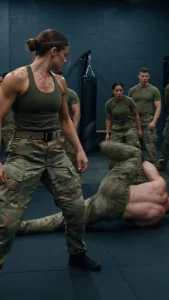
Only moments earlier, Staff Sergeant Owen Knox had knocked Evelyn Reed to one knee while twenty trainees watched. He had expected laughter, embarrassment, and another easy victory over someone he believed did not belong in his course.
Instead, he was staring at a colonel.
“Sergeant Knox,” Hale said, lowering his hand. “Step away from Colonel Reed.”
Knox’s face changed.
“Colonel?”
Evelyn returned the general’s salute with calm precision. She did not smile at Knox’s shock, and she did not look toward the trainees who had laughed at her.
She simply stood straight.
Major General Hale turned toward the class.
“What you witnessed today is not the reason Colonel Reed came here. It is the reason we need to talk.”
Three weeks earlier, Evelyn had entered the training facility under a restricted identity. Her assignment was not to prove she could defeat an instructor. It was to discover whether a demanding military course was testing its trainees fairly—or whether one instructor had begun confusing authority with personal power.
The general had wanted an honest answer.
Now he had one.
But the investigation would reveal something even more important than Knox’s behavior.
It would reveal how many people had seen the problem and convinced themselves it was not their responsibility.

Chapter 1: The Assignment Nobody Could Know About
Three weeks before the confrontation, Colonel Evelyn Reed sat across from Major General Hale in a quiet office.
A thick folder rested between them.
Inside were complaints from soldiers who had attended a joint close-combat training program. Some described humiliating treatment. Others alleged that certain instructors applied different standards to different trainees.
One name appeared repeatedly: Staff Sergeant Owen Knox.
Hale did not claim the allegations were proven.
“I need to know what happens when the people responsible for this course believe senior leadership is nowhere nearby,” he explained.
Evelyn understood.
A scheduled inspection would tell them what instructors wanted senior officers to see. It might not reveal what happened when trainees were exhausted, uncertain, or afraid to challenge someone in authority.
“You want an unannounced evaluation,” she said.
“I want an accurate one.”
Evelyn agreed to enter the course under a restricted trainee identity. The arrangement was authorized, the medical staff were informed, and a small administrative team knew her real status.
Knox and the trainees did not.
Her instructions were straightforward: follow legitimate training requirements, observe how instructors behaved, record what she personally witnessed, and avoid provoking incidents.
She was not there to catch Knox making one mistake.
She was there to determine whether the course was operating according to its own standards.
Chapter 2: The Instructor Who Changed the Rules
At first, the training seemed demanding but professional.
Trainees completed balance drills, controlled-resistance exercises, and physically exhausting sequences designed to test judgment under pressure.
Evelyn had no objection to difficult work.
She had spent much of her career in demanding operational environments. She knew that fatigue could reveal weaknesses and that discomfort was sometimes part of learning.
But training pressure had to serve a purpose.
A correction should improve performance. A difficult exercise should test a defined skill. A failed attempt should provide information about what needed to change.
Knox increasingly seemed interested in something else.
When a confident trainee made a mistake, he corrected the movement and allowed another attempt.
When a quieter trainee made a similar mistake, Knox sometimes stopped the group and turned the error into a public joke.
Evelyn recorded the differences.
She documented the drill, the instruction given, the relevant standard, and what happened afterward. She avoided guessing about Knox’s motives.
Then he began targeting her.
“Are you sure you signed up for the right course?” he asked during one session.
Evelyn ignored the remark and continued training.
Later, he questioned her performance even when she met the published requirements. When male trainees used aggressive movements, he praised their determination. When Evelyn demonstrated comparable intensity, he criticized her control.
She kept recording what she saw.
Her report would need evidence, not anger.
Chapter 3: The Moment the Room Started Laughing

The confrontation began during a routine recovery drill.
The exercise required trainees to maintain balance under pressure and regain a stable position after being displaced.
When Evelyn stepped onto the mat, Knox increased the intensity.
His movement was heavier than it had been with the previous trainee. Evelyn adjusted her stance, but he drove her down onto one knee.
Laughter spread around the room.
Knox stood over her.
“Get on your feet or get out.”
Evelyn rose slowly and brushed a strand of hair away from her face.
“You drop your left side every time you strike,” she said.
Knox smirked.
“You think you can take me?”
“I know I can.”
The words were quiet. She did not raise her voice or invite the audience to take sides.
Knox lunged.
Evelyn moved off the line of the attack, redirected his momentum, and used his own movement to take away his balance.
He hit the mat on his back.
The laughter stopped.
Knox stared at her, furious.
“Cheap shot!”
“I warned you,” Evelyn replied.
She did not celebrate. She did not taunt him or ask the trainees to applaud.
She simply waited.
Then the heavy doors opened.
Major General Hale entered with three officers. The trainees immediately stood at attention.
Hale walked straight toward the mat.
He looked at Evelyn.
Then he saluted.
“Colonel Reed.”
For a moment, nobody moved.
Knox’s expression emptied.
He had spent days questioning whether Evelyn belonged in the course. Now he was learning that she had been sent there to evaluate the course itself.
Chapter 4: Why the General Saluted Her
Knox recovered enough to speak.
“Sir, I didn’t know she was a colonel.”
Hale looked directly at him.
“That is precisely the point.”
Knox frowned.
“Respectfully, sir, if I’d known her rank, I would have handled the situation differently.”
Evelyn answered before the general could.
“Would you have applied the published standard differently?”
Knox hesitated.
“No, ma’am.”
“Would you have corrected the same technical error in a different way?”
He said nothing.
Hale stepped closer.
“Was Colonel Reed below the physical minimum?”
“No, sir.”
“Had she failed the required drill?”
“No, sir.”
“Had she violated discipline?”
Knox looked toward the mat.
“No, sir.”
“Then what justified telling her she did not belong here?”
The question hung in the air.
Knox had no answer grounded in the course’s actual requirements.
He tried to defend the training environment.
“Selection is supposed to be hard. People need to handle pressure.”
“Correct,” Evelyn said. “Pressure is part of training. Personal humiliation is not a substitute for instruction.”
The general nodded.
“Colonel Reed did not come here to demand easier standards. She came to determine whether the standards were being applied consistently.”
He turned toward the trainees.
“Your rank, confidence, personality, or popularity should not determine whether the rules apply to you. The published requirements should.”
For the first time, Knox appeared to understand that the confrontation was not simply about losing a fight.
It was about how he had used his position before the fight ever began.
Chapter 5: The Evidence Behind the Report
Hale ordered Knox removed from instructional duties while the incident and earlier complaints were reviewed.
No public punishment was announced. The command preserved the training footage, collected witness statements, and examined the relevant course standards.
Evelyn submitted her notes.
The footage showed the sequence clearly. Knox had used a different level of resistance with Evelyn than he had used with the preceding trainee. After she pointed out his technical weakness, he moved away from the exercise’s controlled structure and turned the drill into a personal challenge.
The investigators also reviewed earlier complaints.
Some could not be substantiated. Others were consistent with what Evelyn had observed.
Several trainees described being mocked for mistakes that should have received ordinary technical correction. Others said Knox sometimes changed the intensity of an exercise after becoming frustrated with a particular person.
The evidence did not support every allegation.
Evelyn’s report said so.
That mattered. The goal was not to prove every complaint correct simply because Knox had behaved badly during the confrontation. It was to separate supported findings from unsupported claims and ensure that decisions rested on evidence.
The trainees were interviewed separately.
One admitted that he had laughed when Evelyn was knocked down.
“I thought Knox knew what he was doing,” he explained.
Evelyn listened.
“He often does,” she replied.
The trainee looked confused.
“Then why does this matter?”
“Competence does not make every decision correct.”
He lowered his eyes.
“I probably wouldn’t have laughed if I’d known you were a colonel.”
Evelyn held his gaze.
“That’s worth thinking about.”
Chapter 6: The Mistake the Trainees Had Made
The general gathered the class after the initial review.
“Some of you will leave this room with the wrong lesson,” he said.
Nobody spoke.
“You may tell people that Knox picked on the wrong person because Colonel Reed outranked him.”
He paused.
“That is not the lesson.”
Hale explained that Evelyn should have received professional instruction before anyone knew her rank. The same was true of every trainee standing in the room.
The issue was not that Knox had embarrassed a senior officer.
The issue was that he had treated a person differently because he believed she lacked the power to challenge him.
The trainees began to understand their own role.
They had laughed when Knox mocked Evelyn. Their laughter had helped create an atmosphere in which his behavior appeared acceptable.
They had watched him change the exercise. Some had noticed the difference but assumed that questioning an instructor would bring trouble.
Not every witness had done something wrong. Some had been uncertain about what they were seeing. Others had feared the consequences of speaking up.
But the review gave them a chance to reflect on what they could do differently.
One trainee asked Evelyn whether she had planned to defeat Knox from the beginning.
“No,” she answered. “My assignment was to observe the course.”
“Then why did you fight back?”
“Because the exercise had stopped being a controlled drill. I needed to protect myself and end the immediate confrontation.”
She paused.
“The point is not to win every argument. The point is to recognize when something has stopped serving its proper purpose.”
The trainee nodded slowly.
That lesson was harder than any movement on the mat.
Chapter 7: The Findings and the Consequences
The formal review concluded that Knox had repeatedly applied training standards inconsistently and engaged in demeaning conduct unrelated to legitimate instruction.
The review also found weaknesses in the course’s complaint process. Earlier concerns had not been handled consistently, and trainees had lacked a clear route to report problems outside their immediate training chain.
Knox was permanently removed from his instructional role following the review. Further personnel action was handled through the appropriate military procedures.
The command also changed the training program.
Instructors were required to document deviations from prescribed exercises. Trainees received a clearer reporting process. Senior leaders increased unannounced observations, and the course’s evaluation criteria were clarified.
The training did not become easy.
The physical demands remained high. Candidates were still expected to perform while tired, uncomfortable, and under pressure.
What changed was the distinction between difficulty and arbitrariness.
A demanding course could challenge a trainee without degrading them. An instructor could be firm without making the exercise personal.
Hale made that distinction clear during the final briefing.
“Standards are not weakened by applying them fairly,” he said. “They are weakened when people in authority decide they no longer need to follow them.”
Evelyn listened from the back of the room.
She had not entered the course to make Knox look foolish. She had entered to find out whether the system worked when nobody important was watching.
The answer was complicated.
Some parts worked well. Some instructors performed excellently. Some complaints were unsupported. Other problems were real and needed correction.
The report included all of it.
That was what made the findings useful.
Chapter 8: The Return to the Training Mat
Several months later, Evelyn returned to the facility wearing her rank openly.
The same black mat occupied the center of the room. The heavy bags still hung from the ceiling, and the trainees were working through a balance and recovery exercise.
One candidate lost his footing.
The instructor stopped the drill, adjusted the trainee’s stance, and explained the movement again.
The candidate tried a second time and failed.
The instructor corrected him once more.
On the third attempt, the trainee recovered his balance.
The exercise continued.
Nobody laughed.
Evelyn watched quietly.
She did not need the instructor to know she was present. She did not need the trainees to recognize her name. She only needed to see whether the changes had affected the way the course operated.
A young soldier noticed her at the edge of the room.
“Ma’am, are you observing us?”
“For a moment,” she replied.
He straightened.
“Should we do anything differently?”
“Do the exercise correctly. Listen to your instructor. If you make a mistake, learn from it.”
He nodded and returned to the mat.
Evelyn watched for another minute, then left.
That ordinary moment gave her more satisfaction than the confrontation with Knox ever had.
The purpose of the evaluation had never been to expose one instructor in front of a crowd.
It was to make sure the next trainee received fair instruction without needing a senior officer to stand nearby.
Chapter 9: The Apology Evelyn Didn’t Ask For
A few weeks later, Evelyn received a short message from Knox through the appropriate official channel.
He did not ask for his position back. He did not blame the trainees or claim that the review had misunderstood him.
He acknowledged that he had allowed frustration and personal judgment to influence the way he instructed people. He admitted that the course’s demands had become an excuse for behavior that did not improve performance.
Evelyn read the message carefully.
She did not immediately respond.
An apology could be a beginning, but it could not undo the experience of the trainees who had been humiliated. Nor could it automatically restore trust.
Eventually, she sent a brief reply.
She told him that understanding the problem was only the first step. If he wanted to change, he would need to demonstrate it through his future conduct, wherever his career took him.
She did not promise forgiveness.
She did not demand that he remain ashamed forever.
She left the responsibility where it belonged: with him.
Evelyn knew that accountability was not the same as revenge. The purpose of a fair process was to establish the facts, apply appropriate consequences, and reduce the chance that the same conduct would happen again.
Whether Knox would learn from the experience was a decision only he could make.
Chapter 10: Why Evelyn Had Really Been There
Later that evening, Evelyn met Hale in his office to discuss the final report.
“Do you think the course is better now?” he asked.
“I think it is more accountable,” she replied. “Whether it stays that way depends on the people running it.”
Hale nodded.
“You could have revealed your rank the first time Knox challenged you.”
“That would have changed what we were evaluating.”
“You could also have walked away from the confrontation.”
“If it had remained a legitimate drill, I would have continued. When it became a personal challenge, I had to respond to the situation in front of me.”
Hale studied the report.
“You never made this about defeating him.”
“No,” Evelyn said. “One instructor is only part of the story.”
She pointed to the findings about the reporting process.
“If trainees believe nobody will listen, they stop reporting problems. If leaders only inspect a course when they are expected, they see a performance instead of the reality. And if instructors believe authority means they cannot be questioned, even good training can drift away from its purpose.”
Hale leaned back.
“That is why I asked you to go.”
Evelyn stood and gathered her documents.
“Then make sure the changes remain after everyone stops talking about this incident.”
“I will.”
She paused at the door.
“And General?”
“Yes?”
“Next time you review a training program, don’t just ask whether the trainees can handle pressure. Ask whether the people responsible for applying that pressure can be trusted to use it properly.”
Hale nodded.
“I’ll remember that.”
Evelyn left the office and walked down the quiet corridor.
She had entered the course without her rank because she wanted to see how people behaved when they believed rank did not matter.
She left knowing that rank should never have been the reason they behaved well.
The salute had revealed Evelyn Reed’s identity. The investigation revealed the real purpose of her mission.
She had not been sent there to prove that she could defeat an instructor.
She had been sent to discover whether a military training program could recognize the difference between discipline and humiliation—and whether its leaders were willing to correct the problem when the evidence was clear.
That was the victory that mattered.
The End.
A Note for Readers
This is an original fictional military drama inspired by the supplied video scene. It explores leadership, fair training standards, professional accountability, and the responsibility to speak up when authority is misused.