A Little Girl Called Him “Saint”—Then the Biker Learned the Truth
The Name Beneath the Ink
“Saint.”
Lucy said the name so quietly that, at first, I thought I had imagined it.
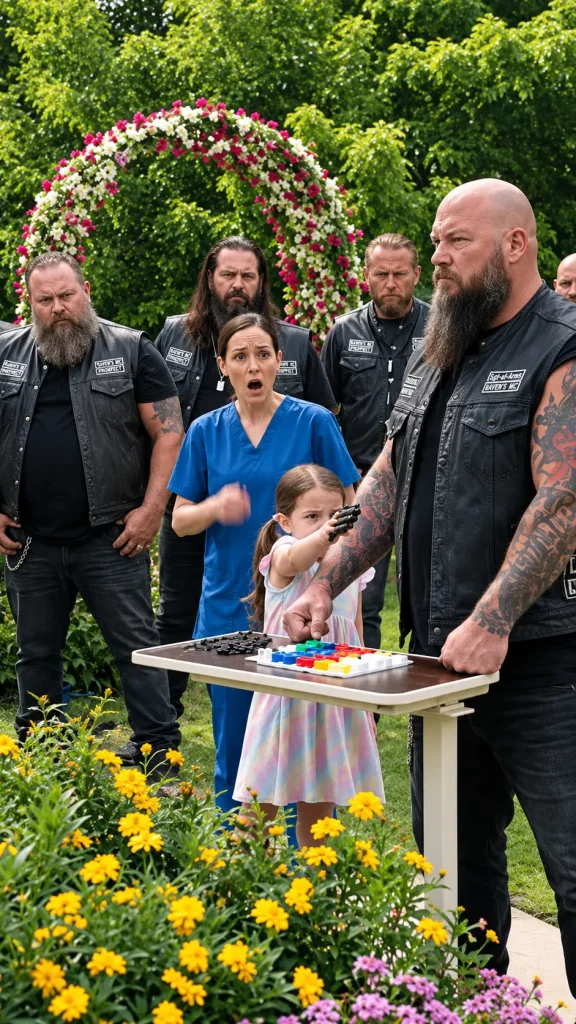
Hammer Dawson did not move. His enormous hand hovered above the tiny compass tattoo on his wrist. Around him, the Iron Harbor Riders stood frozen, their usual confidence replaced by an uneasiness I had never seen before.
Deke Mallory was the first to break the silence.
“That’s enough,” he snapped. “The child is confused. Someone needs to take her inside.”
Lucy flinched.
Hammer noticed immediately.
He lowered his hand, opened his palm, and turned his wrist so the little girl could see the symbol again.
“It’s all right,” he told her. “Nobody is going to make you talk.”
“But you have his mark,” Lucy whispered.
“I do.”
“The man who hurt Mommy had it, too.”
A cold feeling moved through me.
Hammer’s face changed. It wasn’t the expression of a man who had been insulted or accused. It was the look of someone who had just heard a door open in a room he had spent years trying to keep locked.
He turned toward Deke.
“Get the others inside the clubhouse.”
Deke’s jaw tightened. “We need to discuss this privately.”
“We will. But first, everyone is going to give this child some space.”
One by one, the riders stepped away. Deke remained where he was.
“President, think about what you’re doing,” he said. “You’re letting a little girl’s nightmare put the entire club at risk.”
Hammer rose from the tiny yellow chair.
“Then the club can survive a little truth.”
Deke stared at him for another moment before walking toward the gate. As he passed me, I noticed his right hand was clenched so tightly that the silver ring on his finger had left a red mark against his skin.
I remembered that ring.
I remembered Lucy’s terrified description of a man whose hands had looked clean while he did something terrible.
And suddenly, I wanted to know why Deke was so frightened of a seven-year-old girl.
The Brother Hammer Never Discussed
Mara took Lucy into the hospital’s family room, where the lights were soft and the windows overlooked a small garden. A nurse brought her water and a clean towel. Nobody asked her to explain anything.
Hammer waited outside the door.
For the first time since I had met him, he looked uncertain about where he belonged.
I approached him.
“You know who Saint is,” I said.
He nodded.
“Who was he?”
Hammer studied the tattoo on his wrist.
“His real name was Silas Vale. We met when we were boys. Neither of us had much of a family, and we made one out of the people who stayed.”
“Was he the man Lucy saw at the warehouse?”
“I don’t know what she saw clearly. I won’t ask her to relive it just to satisfy my questions.”
That answer surprised me.
“But you recognize the mark.”
“Yes. The broken compass was supposed to mean that no matter how far you lost your way, someone would help you find home.”
“What happened to Silas?”
Hammer looked toward the family-room door.
“Years ago, he left the club after a disagreement. I told people he had gone away. The truth is, I never knew where he went. I kept his name out of conversations because I was ashamed of how things ended between us.”
“Could he have been at the warehouse?”
“I can’t tell you that he wasn’t.”
It wasn’t the answer I wanted, but it was honest.
Before I could ask anything else, Detective Elena Ruiz arrived. She had been contacted by the hospital’s security team after the incident in the courtyard.
She spoke with Hammer first, then with me. When she learned that Lucy had recognized a symbol and named someone connected to Hammer’s past, she made one thing clear.
“No one is going to question that child in a crowd,” she said. “If she wants to tell us something, we’ll arrange it properly, with her guardian and a trained interviewer. Until then, we investigate the adults and the evidence.”
Hammer nodded.
“Whatever you need from me, you’ll get.”
Detective Ruiz glanced at his muddy arms.
“Start by telling me why you came here today.”
Hammer’s eyes lowered.
“Because Grace was my daughter.”
I stared at him.
He had said it without drama, without trying to soften the words. He looked as though he had carried that sentence for years and had finally run out of strength to hold it.
“Lucy is my granddaughter,” he continued. “Grace and I were estranged. She didn’t want me in her life, and she had her reasons. I learned about Lucy from a distance. I wanted to meet her, but I didn’t have the right to walk into her world and demand a place.”
“Did Grace know you were coming today?” I asked.
“No.”
“Then why today?”
“Because I heard the hospital was holding a family event, and I thought I could help without asking anything from her. I wanted to see that Lucy was safe. I never expected her to recognize that tattoo.”
He stopped and swallowed.
“I never expected her to remember him.”
The Truth Hidden in a Memory
Later that afternoon, Mara agreed to meet Detective Ruiz in a quiet consultation room. Lucy stayed with her aunt until a specialist could help her decide whether she wanted to speak.
Hammer did not enter.
He waited outside, his muddy arms resting on his knees.
I sat beside him.
“You could wash your arms now,” I said.
He looked at the dried mud.
“I promised her I wouldn’t.”
“She might not ask you to keep that promise forever.”
“Then I’ll wait until she tells me.”
For several minutes, we listened to the muted sounds of the hospital. A cart rolled past. Someone laughed in the corridor. A child called for her mother.
Ordinary sounds.
Sounds that reminded me that life continued even when a family had been broken by something terrible.
Then Hammer spoke.
“Grace came to me once. A few weeks before the fire.”
I turned toward him.
“She brought papers about the Open Roads program. She thought someone was diverting donations meant for families who needed transportation and medical support. She asked me to help her understand what she had found.”
“Did you help?”
“I promised I would look into it. I told myself I could solve it quietly, without damaging the club.”
“And did you?”
“No.”
He pressed his lips together.
“I kept asking people I trusted whether the records were mistakes. Every answer made it easier to wait another day. I thought protecting the club meant protecting its people. I forgot that the people we were supposed to help mattered more than our reputation.”
“Did you know someone was going to hurt Grace?”
“No,” he said. “But I knew she was frightened, and I should have taken that seriously. I should have gone with her to the police. Instead, I asked her to give me more time.”
He looked at his wrist.
“Sometimes a person doesn’t need to light the match to be responsible for letting a fire spread.”
I had heard many apologies in my work. Some were sincere. Some were only another way to avoid consequences.
Hammer wasn’t asking me to forgive him.
He was finally admitting what he had done wrong.
That was a beginning, not an ending.
The Man with the Silver Ring
Detective Ruiz returned to the consultation room the following morning.
She had obtained records related to the warehouse fire and the charity’s finances. Some documents were incomplete. Others raised questions that had never been properly answered.
The detective explained that the investigation would need independent evidence. Lucy’s memories could be important, but no one would treat a child’s account as the only proof of what happened.
Hammer gave a formal statement. He turned over copies of the financial documents Grace had shown him and the messages he had kept from the period before the fire.
He also provided the names of people who might have known about the missing money.
One name appeared repeatedly.
Deke Mallory.
Deke had managed the club’s accounts and helped administer Open Roads. He had been the loudest person in the courtyard when Lucy covered Hammer’s tattoos. He had also been the first person to insist that her memory was unreliable.
When Detective Ruiz asked the club members about the charity’s finances, their answers differed. Several remembered unusual invoices. One recalled being told not to ask questions about a transportation contractor. Another admitted that Deke had once asked him to move boxes of old records from the foundation office.
None of those details proved who had caused the fire.
But together, they gave investigators reasons to keep looking.
Deke did not return to the hospital.
He called Hammer once.
I was sitting nearby when Hammer answered.
“You need to stop this,” Deke said through the phone.
Hammer’s expression remained still.
“Stop what?”
“Dragging the club through the mud because of something a frightened kid said.”
“She’s a child, Deke. She doesn’t owe us silence.”
“You have no idea what you’re risking.”
“I know exactly what I’m risking. For once, I’m willing to risk it.”
Deke’s voice dropped.
“Saint tried to warn you. You always thought you could save everybody.”
Hammer went pale.
“Where is Silas?”
There was a pause.
Then the call ended.
Hammer immediately handed the phone to Detective Ruiz. He did not call Deke back. He did not send riders to find him. He simply gave the detective what he had.
For a man whose life had been built around protecting his own, it was the first truly different choice he had made.
Lucy’s Choice
Three days later, Lucy agreed to speak with a specially trained interviewer.
Mara stayed nearby. Detective Ruiz remained outside the room, and no one pressured Lucy to remember more than she wanted to share.
I was not present for the interview, and I did not ask for details afterward.
What mattered was that Lucy had been given control.
She could pause. She could ask for Mara. She could say she was finished.
When she came back to the family room, she looked tired but calmer.
Hammer was waiting at the other end of the corridor.
Lucy saw him.
Then she looked at the mud still dried across his tattoos.
“It’s cracking,” she said.
Hammer glanced down.
“Yes.”
“Does it hurt?”
“No, sweetheart.”
“Then why don’t you wash it?”
He thought carefully before answering.
“Because I promised you I wouldn’t. But you can change your mind whenever you want.”
Lucy studied his face.
“You’re not going to be angry?”
“No.”
She took a small step closer.
“You can wash one hand.”
Hammer’s eyes filled, but he didn’t reach for her.
“Are you sure?”
Lucy nodded.
He walked to the nearby sink, turned on the water, and held his left hand beneath it. The mud loosened and ran into the basin. Black ink appeared beneath it: ravens, flames, and the skull Lucy had tried so hard to cover.
She watched without screaming.
When he finished, he turned off the tap.
Lucy looked at the clean hand.
Then she held out a paper bird she had folded in therapy.
It was blue, with one crooked wing.
“I made it for you,” she said.
Hammer accepted it as carefully as if it were made of glass.
“Thank you.”
“It’s not perfect.”
“Neither am I.”
Lucy considered that.
Then, for the first time, she smiled at him without looking away.
It wasn’t forgiveness for everything he had done. She was too young to carry the burden of deciding what he deserved.
It was simply a small moment in which she felt safe enough to offer something of her own.
That was more than he had earned.
And it was more than he had expected.
The Brotherhood Faces the Truth
Over the following weeks, the investigation widened.
Financial records were examined. Former volunteers were interviewed. Investigators revisited the warehouse fire and compared old reports with newly recovered documents.
Deke was eventually located and questioned. Evidence gathered from the charity’s accounts and the warehouse records gave authorities grounds to pursue the case further. His connection to the missing funds became a central part of the investigation, though the questions surrounding the fire required their own careful examination.
Silas Vale was not found where the club expected him to be. His disappearance remained part of the inquiry, and investigators followed the evidence rather than relying on rumors passed between riders.
Hammer did not try to control the investigation.
He stepped down as president of the Iron Harbor Riders while the club arranged an independent review of its finances. The Open Roads program suspended new payments until its records could be audited. The members who had approved questionable transactions were required to answer for their decisions.
Some riders left.
Others stayed and helped investigators locate missing records. A few admitted that they had ignored warning signs because it was easier to trust a brother than to question him.
Hammer never asked them to protect the club’s reputation.
He asked them to help repair what had been damaged.
The money that could be recovered was placed under independent oversight, with priority given to the families and services it had been intended to support. The club also cooperated with the hospital to ensure that Lucy’s treatment continued without interference.
None of those actions brought Grace back.
None of them erased the years Hammer had spent absent from his daughter’s life.
But for the first time, the club’s promise—nobody gets left behind—began to mean something beyond words stitched onto a vest.
It meant staying when the truth became uncomfortable.
It meant protecting a child even when her memories threatened the people you loved.
And it meant understanding that brotherhood without accountability was only another name for silence.
A Different Kind of Promise
Six months later, I found Hammer in the healing courtyard again.
He was no longer wearing his president’s patch. His beard had grown longer, and the lines around his eyes seemed deeper. He was helping a volunteer repair a wooden planter.
Lucy sat nearby with Mara, arranging colored paper into small houses.
She was still working through her grief. Some nights were difficult. Certain sounds could still frighten her, and there were days when she did not want to talk about the warehouse at all.
But she had begun drawing again.
She had started laughing more often.
And she no longer believed that staying hidden had made her responsible for her mother’s death.
Hammer approached the table only after Lucy looked up and nodded.
He carried a small wooden box.
“What’s that?” she asked.
“Something I made.”
He placed it in front of her and opened the lid.
Inside were several paper birds protected beneath a clear cover. The first blue bird Lucy had given him sat in the center. Beside it was a tiny wooden compass, its northern point deliberately left unfinished.
Lucy touched the glass.
“Why is the star broken?”
Hammer sat down on the ordinary bench beside her.
“Because people get lost,” he said. “And sometimes they make mistakes that hurt other people.”
“Can they find their way back?”
“Sometimes. But they have to tell the truth about where they’ve been.”
Lucy looked at him for a long moment.
“Are you still lost?”
Hammer’s eyes glistened.
“Some days.”
She thought about that, then pushed a yellow paper square toward him.
“Then you can make a house.”
He smiled.
“I’ll probably fold it wrong.”
“You always fold it wrong.”
“I know.”
She handed him the paper anyway.
He began folding.
His fingers were still too large for the delicate corners. The roof came out crooked, and one wall leaned to the side. Lucy corrected him, just as she had months before.
This time, when a little piece of paper tore, she didn’t panic.
She simply found another square.
I watched them from the courtyard doorway and thought about the morning Lucy had covered Hammer’s tattoos with mud.
At first, I had believed the moment was about fear: a frightened child confronting a frightening man.
I had been wrong.
It was about a child trying to make sense of something terrible with the only tools she had. It was about a man discovering that the strongest thing he could do was remain still, listen, and let someone smaller than him decide what safety looked like.
The truth about Grace would take time to fully emerge. The investigation would continue. There would be consequences, grief, and questions that no court could answer.
But Lucy had learned something important.
A frightening memory did not have to control every day that followed it.
And Hammer had learned something just as difficult.
Love was not proven by how fiercely a person defended his own. It was proven by whether he was willing to tell the truth, accept consequences, and protect those who could not protect themselves.
Before Lucy left that afternoon, she took Hammer’s hand.
Not because she had forgotten what happened.
Not because his past no longer mattered.
But because, for one small moment, she wanted to.
Hammer held her hand gently.
His tattoos were visible. The ravens, skulls, and flames had not disappeared. They had never been the whole story of who he was.
Neither had his mistakes.
Lucy looked up at him.
“You can wash both arms now,” she said.
Hammer nodded.
“Thank you, Lucy.”
She gave him a tiny, serious smile.
“But don’t wash off the bird.”
He glanced at the blue paper bird resting safely inside the wooden box.
“I wouldn’t dream of it.”
And for the first time in years, the giant biker walked out of the hospital courtyard without trying to hide the marks on his skin—or the truth about the man he had been.
THE END