Why Soldiers Still Trust Analog Watches in Modern Warfare
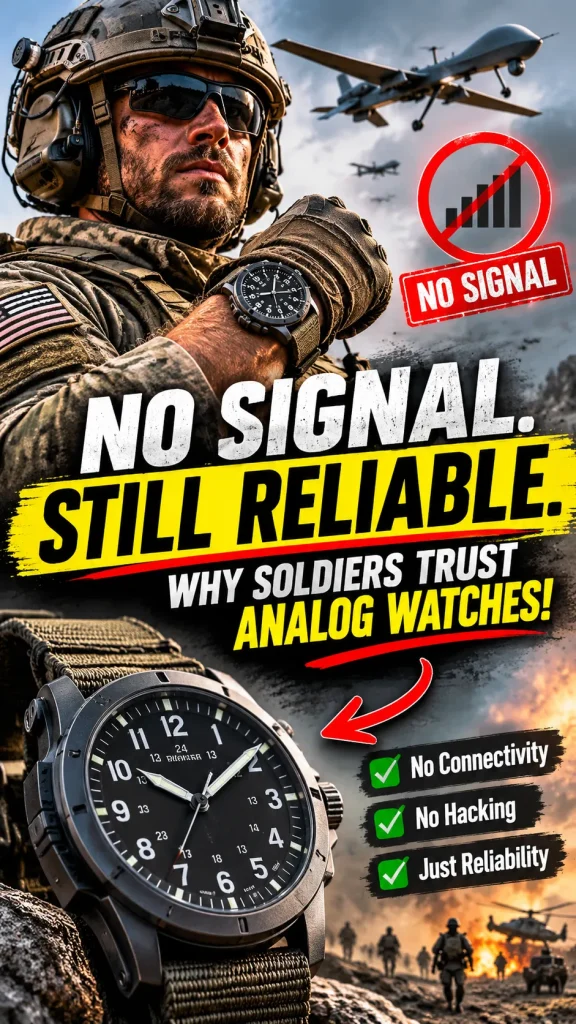
Why Soldiers Still Trust Analog Watches: No Signal, No Connection, Just Reliability
The Modern Battlefield Is Digital. So Why Does the Analog Watch Still Matter?
Modern warfare is changing faster than ever.
Drones can monitor large areas. Electronic warfare can disrupt communications and navigation systems. Satellites provide positioning information, while connected devices help military personnel exchange data across enormous distances.
Yet one simple piece of equipment continues to have a place in military life: the wristwatch.
It doesn’t need an internet connection. It doesn’t require a mobile network. It doesn’t need a satellite signal to display the time.
For soldiers working in demanding environments, that simplicity can be valuable.
But does that mean analog watches are better than smartwatches? Not necessarily. Modern military personnel use a variety of timekeeping devices, including digital watches and advanced wearable technology.
The real advantage of an analog watch is that it can provide a simple, independent way to check the time without relying on connected features.
Let’s explore why this traditional piece of equipment still deserves attention.
1. A Battlefield That Depends on Technology
Military operations increasingly involve interconnected systems.
Drones provide aerial observation. Digital maps help personnel understand their surroundings. Satellite navigation supports positioning, while secure communications allow teams to coordinate.
These technologies offer major advantages.
However, connected systems also introduce dependencies. A device may need power, a working connection, compatible software, or access to external information to deliver all its features.
Electronic warfare can interfere with certain communications and navigation links. Equipment can also fail because of damaged hardware, depleted batteries, environmental conditions, or software problems.
This does not mean all digital technology stops working when communications are disrupted. Many devices have offline capabilities and independent functions.
But it does highlight the value of carrying equipment that can perform its basic purpose without depending on a network.
That is where a simple watch becomes relevant.
2. No Internet Required: The Value of Independent Timekeeping
An ordinary analog watch displays time directly on its dial.
A traditional mechanical watch uses a wound mainspring and a mechanical movement. It does not require a battery or an external network to keep operating, although it does need regular winding and maintenance.
A quartz analog watch is different. It uses a battery-powered electronic movement, but it still does not need internet connectivity or GPS to display the time.
This distinction matters.
The phrase “analog watch” describes how time is displayed, not necessarily how the watch is powered.
For military use, the important question is whether the timepiece can provide dependable timekeeping without relying on unnecessary external services.
A basic watch can continue displaying time even when a phone has no signal or a network connection is unavailable.
That is a useful form of independence.
3. Why Connectivity Can Be a Disadvantage
Smartwatches can provide impressive capabilities.
Depending on the model, they may include GPS, wireless communications, digital maps, health sensors, notifications, and activity tracking.
These features can be useful in training, fitness, navigation, and other applications.
However, more features also mean more systems to manage.
A connected wearable may communicate with a smartphone, use wireless protocols, synchronize information, or access location services.
In sensitive environments, device emissions and data handling may matter. Military personnel therefore need to follow their unit’s equipment and operational-security rules.
An analog watch has a much simpler electronic profile.
A mechanical watch has no wireless transmitter. A basic quartz analog watch also does not normally transmit wireless signals.
That does not make every analog watch automatically undetectable or suitable for every mission. It simply means a basic timepiece does not need to communicate with external networks to perform its primary function.
4. Reliability: Fewer Features, Fewer Dependencies
Reliability is not just about how strong a device looks.
It also involves how many things must work correctly for the device to perform its intended job.
A smartwatch may depend on a rechargeable battery, software, sensors, and other electronic components. Some features may be unavailable when power is low or when external services cannot be reached.
A mechanical watch avoids many of those electronic dependencies.
However, mechanical watches are not maintenance-free. They can lose accuracy, suffer damage from shocks, require servicing, and be affected by magnetic fields depending on their design.
Quartz watches also have limitations, particularly battery life and the need for eventual battery replacement.
The most sensible choice depends on the environment and the user’s requirements.
For someone who wants a simple way to check the time, a well-built analog watch can be an excellent tool.
5. Battery Life and Power Independence
Power management is an important consideration when selecting field equipment.
Smartwatches often require periodic charging. Battery life varies widely depending on display settings, GPS use, wireless connectivity, sensors, and the specific model.
A traditional mechanical watch does not use a battery. It runs through stored mechanical energy from its mainspring.
A quartz analog watch uses a battery, but basic models can often operate for a long period before replacement is needed.
This creates several different options:
- Mechanical analog: No battery required, but regular winding and maintenance may be necessary
- Quartz analog: Battery-powered, usually with a simple time display and no network dependency
- Digital watch: May offer alarms, timers, and additional functions, depending on the model
- Smartwatch: Can provide advanced connected features, but may need more frequent charging
The best choice is not always the most advanced one.
Sometimes, a simple device that performs one job consistently is exactly what the user needs.
6. Readability in Difficult Conditions
A watch is only useful if its wearer can read it.
Military-style watches often emphasize clear dial layouts, strong contrast, durable cases, and visibility in low-light conditions.
Some models use luminous hands and markers. Others incorporate illumination systems or specialized displays.
The U.S. military’s MIL-PRF-46374G watch specification describes requirements for general-purpose watches, including readability in low or no-light conditions for extended periods.
This illustrates that readability has long been an important consideration in military timekeeping.
A clean analog dial can make the time easy to understand at a glance.
Digital watches can offer equally clear displays, and some provide better visibility in particular environments. The choice depends on display design, lighting, and user preference.
7. A Long History of Military Timekeeping
Watches have played an important role in military history for generations.
Before modern digital technology, soldiers, pilots, sailors, and navigators depended on accurate timekeeping to coordinate activities and maintain schedules.
During the Second World War, military organizations used watches designed for different service requirements.
The American A-11 became one of the best-known wartime military watch designs. Its clear dial and practical construction reflected the need for dependable timekeeping.
Military watches also developed for aviation and naval applications, where accurate time could be important for navigation and coordination.
Over the following decades, quartz technology and digital watches changed the market.
The military’s relationship with watches changed too. Today, personnel may use digital watches, GPS-enabled devices, smartwatches, or simple analog timepieces depending on their role and preferences.
Analog watches are no longer the universal military standard they once were, but their design principles remain relevant.
8. Analog vs. Smartwatch: Which Is Better for Field Use?
There is no single answer for every soldier or environment.
Both types of watches have advantages.
| Feature | Basic Analog Watch | Smartwatch |
|---|---|---|
| Displays time without internet | Yes | Usually yes |
| Wireless connectivity | Usually none | Often available |
| GPS functions | Usually no | Available on many models |
| Health tracking | Usually limited or absent | Available on many models |
| Charging | Mechanical models need no battery | Usually rechargeable |
| Simplicity | Generally very simple | More features and settings |
| Maintenance | Depends on movement and construction | Software and battery management may be needed |
| Notifications | No | Available on many models |
A basic analog watch is attractive to someone who values simplicity and independence.
A smartwatch is attractive to someone who needs navigation, fitness information, digital tools, or other advanced features.
The important point is that the two devices serve different priorities.
9. Why Simplicity Still Matters
Technology is most useful when it solves a real problem.
More features do not automatically mean better performance in every environment.
A soldier may need advanced digital equipment for one task and a simple, dependable tool for another.
The analog watch represents a useful design philosophy: keep the essential function available without making it dependent on unnecessary systems.
It doesn’t replace GPS.
It doesn’t replace secure communications.
It doesn’t replace modern military technology.
It simply provides time.
And sometimes, having a basic tool that continues performing its intended function is valuable in its own right.
Conclusion: The Future Is Digital, but Simple Tools Still Have a Place
Modern warfare will continue to evolve.
Drones, electronic warfare, artificial intelligence, satellite systems, and connected equipment will keep changing how military operations are conducted.
But technological progress does not make every traditional tool obsolete.
A basic analog watch can offer independent timekeeping, a straightforward display, and freedom from wireless connectivity requirements.
That doesn’t mean analog watches are always more reliable or more suitable than digital devices. The right choice depends on the mission, the equipment, and the operating environment.
The lesson is simple:
The best tool is not always the one with the most features. It is the one that reliably does the job it was chosen to do.
So, which would you choose in the field: a traditional analog watch or a modern smartwatch? Share your thoughts in the comments.
This article is an educational overview of military timekeeping and watch technology. It does not provide operational guidance or claim that one watch type is universally used or preferred by all armed forces.