Ava Cordero Called Her Father After a General Humiliated Her — Then the Doors Opened
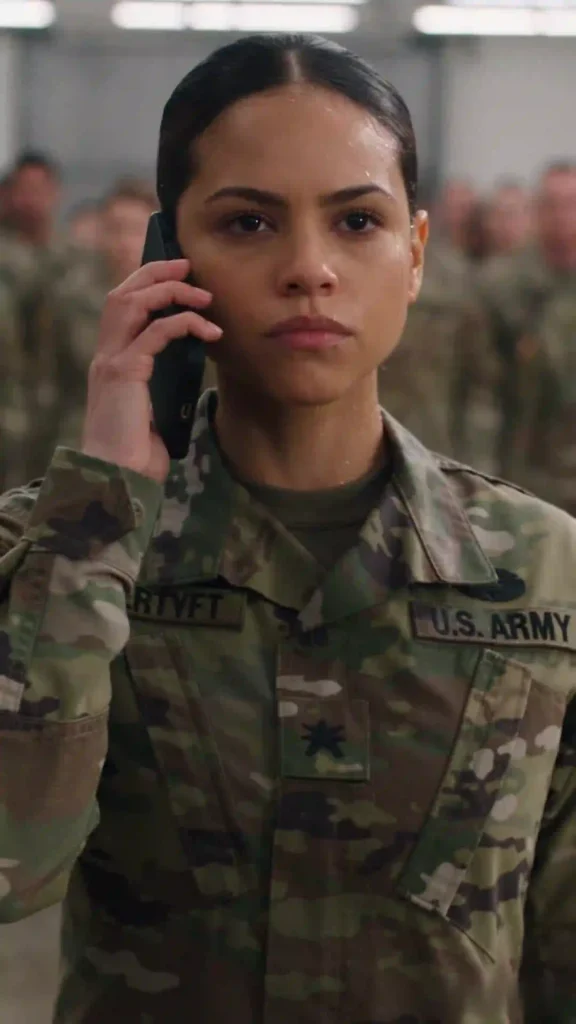
Ava Cordero Called Her Father After a General Humiliated Her — Then the Doors Opened
Chapter 1: The Man Who Walked Through the Doors
The double doors at the far end of the hall flew open with a deep crash.
Every head turned.
A tall officer entered first, followed by two uniformed aides. His dark dress uniform carried rows of decorations, and his expression was so controlled that it made the silence in the room feel even heavier.
General Harris Thorne’s smirk began to fade.
The arriving officer didn’t look at him.
He looked directly at Ava Cordero.
“Specialist Cordero,” he said, his voice calm and unmistakably authoritative.
Ava straightened despite the water soaking her uniform.
“Sir.”
He stopped a few feet in front of her, noticed the wet fabric, the trembling in her hands, and the empty bucket still resting near Thorne’s side.
Then he turned toward the general.
“Would you care to explain what happened here?”
Thorne recovered quickly.
“General, this is an internal disciplinary matter. The specialist has repeatedly demonstrated an unacceptable attitude, and I was correcting her conduct.”
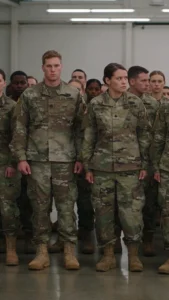
The newcomer glanced at the fifty soldiers standing around the hall.
“By pouring water over her in front of an audience?”
Thorne’s jaw tightened.
“I was establishing authority.”
“No,” the officer replied. “You were demonstrating how you use it.”
A quiet murmur moved through the assembled soldiers.
For the first time that morning, Thorne appeared uncertain.
He looked again at Ava.
“Who exactly did you call?”
Ava answered without raising her voice.
“My father, sir.”
The general’s face changed.
Not dramatically. Not enough for most people to notice.
But Ava noticed.
And so did the officers standing closest to him.
Because General Daniel Cordero was not simply her father.
He was the senior officer who had just walked into the room.
Chapter 2: The Name Thorne Never Expected to Hear
General Daniel Cordero had spent more than three decades in uniform.
He had led soldiers through difficult deployments, overseen demanding training programs, and earned a reputation for asking difficult questions rather than accepting convenient answers.
He was also a father who had taught his daughter that rank meant responsibility, not permission to humiliate people.
Thorne had apparently never bothered to discover their relationship.
“General Cordero,” Thorne said, forcing a smile. “I wasn’t aware Specialist Cordero was your daughter.”
Cordero’s expression remained unchanged.
“Would that knowledge have altered your behavior?”
The question hung in the air.
Thorne opened his mouth, then closed it.
Cordero continued.
“Because if your conduct depends on whether a soldier has a powerful relative, we have a much larger problem than a disciplinary disagreement.”
Ava looked down briefly.
She had imagined this moment in a dozen different ways during the five minutes she waited for her father. She had imagined anger, confrontation, even the possibility that Thorne would immediately be relieved of his authority.
Instead, her father was doing something far more uncomfortable.
He was asking questions in front of witnesses.
“General Thorne,” Cordero said, “I want a factual account of what happened before I draw any conclusions. You may explain your position, but nobody in this room will be threatened or instructed to change their statement.”
Thorne stiffened.
“Of course, sir.”
“Good. Have the hall secured for an official review. Preserve any available video, and identify everyone who witnessed the incident.”
Cordero turned toward the soldiers.
“If you saw what happened, tell the truth. Not what you think a superior wants to hear. Not what you believe will protect your career. The truth.”
For several seconds, no one moved.
Then a young corporal stepped forward.
“Sir, I saw the entire incident.”
Another soldier raised his hand.
“So did I.”
Within moments, several others began speaking.
The silence that had protected Thorne only minutes earlier was finally breaking.
Chapter 3: Fifty Witnesses
The investigation began that afternoon.
Each witness was interviewed separately. Their accounts were compared, and investigators collected the available recordings, duty logs, and written instructions connected to Ava’s assignment.
The evidence established that Thorne had deliberately poured water over Ava in front of the assembled personnel and had made degrading remarks about her family.
But the inquiry did not stop there.
Ava’s immediate supervisor disclosed that Thorne had criticized her repeatedly during the preceding weeks. Other soldiers described similar incidents involving personnel who questioned his decisions or failed to meet his personal expectations.
Some accounts were supported by written messages and contemporaneous reports. Others required additional verification.
For Ava, the hardest part was not describing what had happened.
It was listening to the reasons people had remained silent.
“I thought he would destroy my career,” one specialist admitted.
“I assumed someone above him already knew,” another said.
A young lieutenant looked down at his hands.
“I told myself it wasn’t my responsibility.”
Ava remembered every face that had watched her stand beneath that bucket.
She had been angry with them.
Now she understood that fear had played a part in their silence. But understanding the fear did not mean pretending it had caused no harm.
During her own interview, an investigator asked whether she had called her father because she expected him to intervene.
Ava considered the question carefully.
“I called him because General Thorne demanded that I do it,” she answered. “He thought it would prove that nobody would stand behind me.”
“Did you expect your father to arrive in person?”
“Honestly? I hoped he would listen. I didn’t know what he would do.”
She paused.
“But I don’t want special treatment. I want the same rules to apply to everyone.”
The investigator wrote down her answer.
It was the same principle her father had insisted upon from the moment he entered the room.
The inquiry would not assume that Thorne was guilty of every allegation simply because of the public incident. It would establish what could be proven, give those involved an opportunity to respond, and recommend action based on the evidence.
For the first time in a long while, the soldiers in that hall had reason to believe their statements might actually matter.
Chapter 4: The General’s Biggest Mistake
Three days later, Thorne was called to a formal meeting with senior leadership.
General Cordero did not preside over the disciplinary decision. Given his relationship with Ava, he had disclosed the conflict and left the matter to the appropriate independent authorities.
That decision frustrated some people who wanted an immediate public confrontation.
But Cordero understood that accountability had to be more than a personal victory.
The preliminary findings were serious.
Witness statements consistently described the public humiliation. Available footage supported the central details of the incident. Investigators also identified concerns about Thorne’s previous treatment of personnel, although each separate allegation required its own review.
Thorne argued that his intention had been to enforce discipline.
The reviewing officer asked him a simple question.
“What specific military objective required you to pour water over a subordinate and insult her parents?”
Thorne had no convincing answer.
He had confused obedience with respect and authority with immunity.
The review concluded that his conduct had violated applicable standards of professional behavior. He was removed from his training leadership responsibilities pending the appropriate administrative and disciplinary process.
Further action would depend on the findings and the governing procedures.
When the decision was announced, the soldiers who had witnessed the incident understood that the consequences were not the result of Ava’s family connections.
They were the result of evidence.
Thorne had believed that the room belonged to him because he held the highest rank in it.
His mistake was assuming that rank made his actions unquestionable.
It did not.
Chapter 5: A Daughter, Not a Privilege
A week later, Ava met her father at a quiet outdoor seating area near the administrative buildings.
She was wearing a clean uniform. Her training schedule had resumed, and she was determined not to let the incident become the only thing people remembered about her.
Cordero sat opposite her with two cups of coffee.
“How are you holding up?” he asked.
“I’m fine, Dad.”
He gave her a familiar look.
“That wasn’t what I asked.”
Ava sighed.
“I’m angry. Not just at him. At everyone who watched and did nothing.”
“That’s understandable.”
“Did you know how bad things had become?”
“No,” he admitted. “And I should not pretend otherwise.”
She studied his face.
“Some people are saying you came here because I’m your daughter.”
“I came because a soldier called for help. The fact that you’re my daughter makes it even more important that I avoid using my position to influence the outcome.”
Ava looked toward the training field.
“I never wanted to use your name.”
“I know.”
“I wanted to earn my place.”
Cordero leaned forward.
“Then keep earning it. Don’t let what happened convince you that you must be twice as good as everyone else just to deserve the same respect.”
For the first time since the incident, Ava felt the tightness in her chest begin to ease.
Her father had not promised to make every problem disappear.
He had reminded her that she did not need his rank to establish her own worth.
Chapter 6: The Apology Nobody Expected
Several weeks later, Thorne requested permission to address the personnel who had witnessed the incident.
The request was reviewed through the proper chain of command.
When the meeting finally took place, he stood at the front of the same hall where he had humiliated Ava.
This time, there was no bucket.
No mocking laughter.
No audience waiting to see who would be embarrassed next.
Thorne looked older than he had that morning.
“I believed that fear was an effective way to maintain discipline,” he began. “I used my position to humiliate a subordinate, and I justified my actions by calling them training.”
He paused.
“That was wrong.”
His gaze moved across the room until it reached Ava.
“Specialist Cordero, I apologize for what I did to you. I also apologize to the personnel who witnessed it and were placed in a position where they believed they had to remain silent.”
Ava listened without interrupting.
She did not smile or offer immediate forgiveness.
“Thank you for acknowledging what happened, General,” she said. “What matters now is whether the lesson changes how people are treated in the future.”
Thorne nodded.
It was not a dramatic reconciliation. One apology could not erase the humiliation or restore every ounce of trust he had lost.
But it was a beginning.
The formal consequences of his conduct remained separate from his personal decision to apologize.
And Ava understood that both accountability and change mattered.
Chapter 7: The Hall That Fell Silent for a Different Reason
Months passed.
The incident stopped dominating conversations around the base, but its lessons remained part of the training program.
Personnel received clearer guidance on professional conduct, reporting procedures, and the responsibility to speak up when they witnessed mistreatment.
The changes were not presented as a victory for one family or one individual. They were intended to protect every soldier, regardless of rank, background, or connections.
Ava returned to her duties and continued training.
She never became known as the specialist whose father was a general.
Among the people who worked with her, she became known for something more important: her composure under pressure, her commitment to her responsibilities, and her refusal to treat other people as less deserving of respect.
One afternoon, a young soldier approached her after a training exercise.
“Specialist Cordero, can I ask you something?”
“Go ahead.”
“How did you stand there without breaking down when everyone was watching?”
Ava thought about the question.
“I didn’t feel strong every second,” she admitted. “I was angry, embarrassed, and afraid of what might happen next.”
The soldier looked surprised.
“But you didn’t show it.”
“Strength isn’t about pretending you never feel anything. It’s about deciding what to do when those feelings arrive.”
She paused before adding, “And if someone abuses their authority, you don’t have to face it alone. Find the right people, document what happened, and tell the truth.”
The soldier nodded and thanked her.
That evening, Ava walked past the hall where the incident had taken place.
She remembered the cold water, the general’s laughter, and the fifty soldiers who had watched without speaking.
Then she remembered the doors opening.
Not because a powerful man had arrived to settle a personal score, but because the moment had forced an entire room to confront a question it had avoided for too long.
What does leadership mean when nobody is brave enough to challenge it?
Ava knew the answer now.
Leadership was not the ability to make fifty people afraid of you.
It was the willingness to protect those fifty people, even when doing so was difficult.
And respect was not something a uniform automatically granted.
It was something a person had to earn through their actions.
Ava straightened her shoulders and continued toward the training field.
She had a job to do.
She had a future to build.
And she no longer needed anyone’s permission to know that she belonged.
THE END