He Slapped Her… Then the Commander Saw Her Tattoo
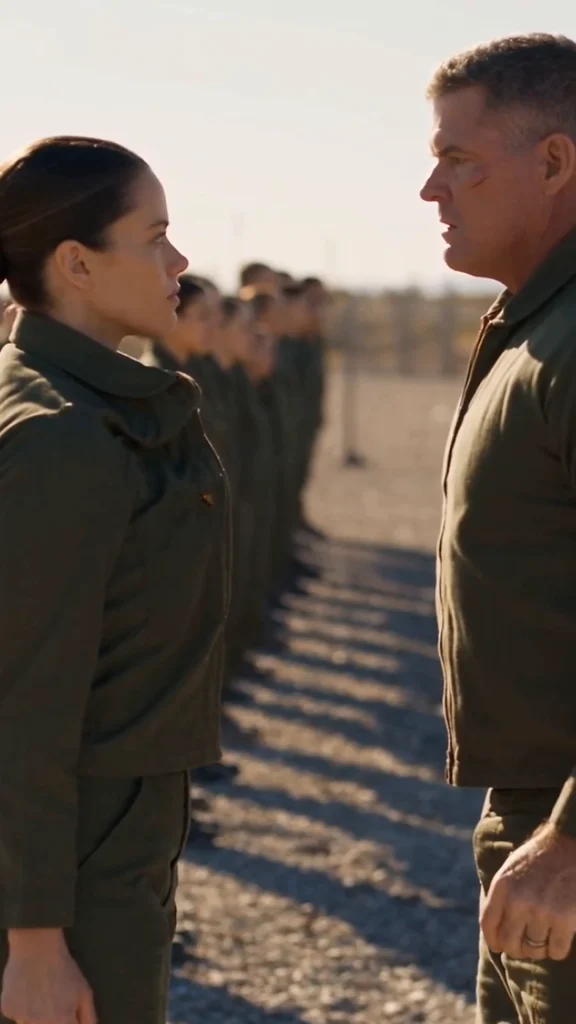
He Slapped Her… Then the Commander Saw Her Tattoo 😳
Chapter 1: The Name That Changed the Room
“You know exactly who he is.”
Julian Whitmore’s voice echoed through the conference room.
For years, those words had been enough to silence instructors, frighten recruits, and make people reconsider decisions they had already made.
But this time, Commander Elias Rourke didn’t look impressed.
He looked at Julian as if he were seeing him clearly for the first time.
“Yes,” Rourke replied. “I know exactly who your father is. That’s why nobody is leaving this room until the investigation is complete.”
Charles Whitmore adjusted his expensive watch.
“Commander, I suggest you think very carefully about your next words. My company supplies technology to installations across the country. General Harland can confirm the importance of our relationship with the military.”
General Nathan Harland remained silent.
That silence appeared to irritate Charles more than any accusation could have.
“General?”
Harland slowly removed his cap and placed it on the table.
“Charles, I was told this was a disciplinary incident involving your son.”
“It is.”
“No,” Harland replied. “Apparently, it is considerably more than that.”
Charles’s expression hardened.
Then he noticed the woman sitting opposite him.
Mara Vance hadn’t moved since entering the room. Her uniform collar concealed the tattoo that had turned Commander Rourke pale only hours earlier.
She looked at Charles without anger or fear.
“It’s been a long time,” she said.
Charles stared at her.
For a fraction of a second, his carefully maintained expression broke.
Then he smiled.
“I don’t believe we’ve met.”
Mara tilted her head slightly.
“You signed the documents.”
“I’m a businessman. I sign thousands of documents.”
“You signed the agreement that transferred the Spearpoint records into a private archive.”
Charles’s smile disappeared.
Daniel Mercer, who had been standing beside the conference table, felt his stomach tighten.
He had heard the name Spearpoint earlier that morning. He had learned enough to understand that it was connected to something terrible.
But he still didn’t understand why a defense contractor would be frightened of one quiet soldier.
Mara placed a thin folder on the table.
“Perhaps you’ll remember the project once you see the original authorization.”
Charles didn’t open it.
Instead, he turned toward General Harland.
“This is absurd. She is an enlisted recruit making allegations against a company she knows nothing about.”
Mara’s expression remained unchanged.
“Then opening the folder shouldn’t concern you.”
For several seconds, nobody spoke.
Finally, General Harland reached for the folder.
And Charles Whitmore took his first step toward the door.
Two military police officers moved in front of it.
“Please remain here, sir,” one said.
Charles looked at them with disbelief.
“You have no idea what you’re doing.”
General Harland opened the folder.
The first page contained an old photograph of a training facility. The second showed a list of names, most of them redacted.
On the third page was a familiar emblem: a fractured spearhead surrounded by three jagged lines.
The same symbol hidden beneath Mara’s collar.
Harland’s face changed.
“Where did you obtain this?”
“From the original archive,” Mara answered.
“That archive was destroyed.”
“No, General. The public copy was destroyed.”
She paused.
“The original was never recovered.”

Chapter 2: The Girl Behind the Number
General Harland turned another page.
A handwritten note appeared beneath a series of dates.
Commander Rourke recognized the signature immediately.
His own.
He sat down slowly.
“I thought that file had been buried forever,” he whispered.
Mara looked at him.
“You thought the file had disappeared. That’s not the same as believing the people in it deserved justice.”
Rourke lowered his eyes.
Twenty-one years earlier, he had been a young officer assigned to security at a privately funded research facility. He had been told that the children inside were volunteers participating in a resilience study.
He had never been allowed to enter their rooms.
He had heard the alarms. He had heard the crying. He had filed a report after witnessing a frightened child being dragged down a corridor.
The report had vanished.
His superiors had told him the matter was being handled. He had accepted reassignment and eventually moved on with his career.
For years, he had convinced himself that he had done everything an officer could reasonably do.
Then he had seen Mara’s tattoo.
The mark was not a unit insignia. It was an identification code assigned to children enrolled in Project Spearpoint.
Mara had been seven when the program began for her.
She had been twelve when it ended.
“Why did you come here?” Rourke asked quietly.
Mara looked at the window.
“Because someone started using the same methods again.”
She explained that investigators had discovered unusual data transfers connected to military training technology supplied by Whitmore Strategic Systems. The equipment was supposed to measure equipment performance and training efficiency.
Instead, some systems appeared to be collecting far more information than their approved specifications allowed.
Biometric readings. Stress responses. Movement patterns. Behavioral predictions.
The investigation had not yet established who had authorized every transfer or where all the data had gone.
But several archived contracts contained references to a discontinued research program.
Project Spearpoint.
Charles Whitmore shook his head.
“These are allegations. Data collection is a normal part of modern defense technology.”
“Authorized data collection is,” Mara replied. “Secretly retaining restricted information is another matter.”
“You have no proof I ordered anything illegal.”
“That’s what the investigators are here to determine.”
Charles leaned forward.
“You think a tattoo makes you important?”
For the first time, something changed in Mara’s eyes.
“No. It reminds me of what happens when powerful people decide that children are acceptable losses.”
The room fell silent.
She continued, her voice controlled.
“I didn’t come here to make you afraid of me. I came here because the records were disappearing again, and this installation was one of the last places where the original equipment could still be examined.”
Daniel finally understood.
Mara hadn’t joined the training program to prove she was stronger than the other recruits.
She had come to find evidence.
And Julian, with his arrogance and constant references to his father, had unknowingly brought the investigation directly into the open.

Chapter 3: The Son Who Thought He Was Untouchable
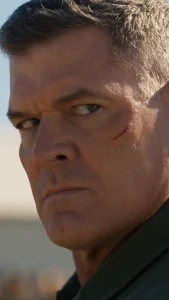
Julian had been listening with growing disbelief.
He looked at his father.
“Tell them she’s lying.”
Charles didn’t answer.
“Dad?”
“Be quiet, Julian.”
The words struck harder than any reprimand Julian had received during training.
His father had always protected him. When Julian broke rules, someone else usually paid the price. When an instructor complained, a phone call often followed. When he bullied another recruit, the incident somehow became a misunderstanding.
Julian had interpreted every escape as proof that he was untouchable.
Now he was beginning to wonder whether his father had protected him for a different reason.
“Did you know about Spearpoint?” he asked.
Charles turned sharply.
“This is not the time.”
“Did you?”
“I said be quiet.”
Julian stepped backward.
For the first time, he noticed that his father wasn’t trying to defend him.
He was trying to stop him from speaking.
The memory of the training yard returned.
Mara standing perfectly still.
Her split lip.
That strange smile.
He had believed she was laughing at him.
Now he wondered whether she had been waiting for the truth to surface all along.
General Harland closed the folder.
“Captain Morrell, preserve all relevant records. No files are to be altered, transferred, or destroyed. Contact the appropriate independent investigators and legal authorities.”
Charles stood.
“You cannot seize private company records based on a folder of allegations.”
Harland met his gaze.
“We aren’t deciding guilt in this room. We’re preserving evidence so the facts can be established lawfully.”
“And my son?”
“Cadet Whitmore will remain under the applicable disciplinary process. The investigation into the company will be handled separately.”
Charles’s expression turned cold.
“Julian, say nothing else.”
But Julian had already begun to understand the cost of obeying that command.
He looked at Mara.
“Did you know what would happen when I hit you?”
She took a moment before answering.
“I knew your behavior had been documented. I didn’t know you would strike me.”
“Then why were you smiling?”
“Because I realized you were finally going to do something nobody could explain away as a misunderstanding.”
Julian looked down.
For once, he had no clever response.
Chapter 4: The Evidence in the Training Yard
The investigation began before sunset.
Investigators secured the training equipment, preserved digital records, and interviewed recruits and instructors separately. The military police collected statements about the assault.
Daniel Mercer was called into a small interview room.
An investigator placed a notepad in front of him.
“Tell us exactly what you saw.”
Daniel described the incident from the beginning.
He explained how Julian had stepped on Mara’s ankle, how she had told him to watch his feet, and how Julian had struck her before she could move away.
Then the investigator asked the question Daniel had feared.
“Did you initially intend to report what you witnessed?”
Daniel hesitated.
“No, sir.”
“Why not?”
“Because I thought nothing would happen.”
The investigator waited.
Daniel swallowed.
“Everyone knew who Julian’s father was. People had complained about his behavior before, and nothing changed. I thought speaking up would only make my own training harder.”
“Did anyone threaten you directly?”
“No.”
“Then what stopped you?”
Daniel looked at his hands.
“Fear. Not the kind where someone points a weapon at you. The kind where you convince yourself that telling the truth is pointless.”
The investigator wrote something down.
“Did you see Julian deliberately step on Mara’s ankle?”
Daniel remembered Julian looking down before his boot came down.
“Yes,” he said. “I believe it was deliberate.”
This time, he didn’t soften the answer.
Across the installation, other recruits were making similar statements. Some described the humiliation they had witnessed. Others admitted they had laughed at Julian’s jokes because they were afraid of becoming his next target.
Their accounts didn’t prove every allegation against Charles Whitmore.
But they established a pattern of misconduct that could no longer be dismissed as one recruit’s personal dispute.
The training yard had become the first place where people were willing to speak openly.
And that mattered.
Chapter 5: The Commander Faces His Past
That evening, Mara found Commander Rourke standing alone outside the administration building.
The sky had darkened, and the air had finally begun to cool.
Rourke turned when he heard her footsteps.
“Your lip should be examined again.”
“It has been examined.”
“Then you should rest.”
“Is that an order?”
He almost smiled.
“No, ma’am.”
She stopped beside him.
For a while, neither spoke.
Finally, Rourke said, “I remember a girl who used to stand outside the observation room. She never cried when the others did.”
Mara looked toward the distant training lights.
“There were several children like that.”
“I remember her number.”
“You remember a number,” Mara replied. “You don’t remember what they called her.”
Rourke’s face tightened.
“What was her name?”
“Lena.”
He closed his eyes.
Lena had been eight years old. She had once asked him whether the doors were locked because the adults were afraid of the children escaping.
He had told her the doors were locked for her safety.
He had repeated the explanation because it was what his superiors had told him to say.
Two weeks later, Lena was transferred to another facility.
He never saw her again.
“Did she survive?” he asked.
Mara’s answer was quiet.
“I don’t know.”
The words seemed to take the strength out of him.
“I filed a report.”
“I know.”
“They told me it was being investigated.”
“And you believed them.”
“I was young.”
“So were we.”
Rourke looked at her, unable to answer.
Mara did not raise her voice.
“You don’t have to pretend you were the person who designed the program. But you cannot pretend that standing outside the door made you innocent of everything that happened inside.”
He stared at the ground.
“What do you want from me?”
“The truth. All of it. Even the parts that make you look bad.”
“And if it ends my career?”
Mara finally turned toward him.
“Then your career will be one of the things you lost by staying silent. It won’t be the worst thing the children lost.”
She walked away before he could respond.
For the first time in twenty-one years, Rourke began writing a statement without asking anyone how to protect his future.
Chapter 6: The File Charles Could Not Destroy
By the following morning, the investigators had located a second archive.
It was stored on a server maintained by a subcontractor that had recently ended its relationship with Whitmore Strategic Systems. The records included old Spearpoint documents, equipment contracts, and newer technical logs associated with several military installations.
The evidence was incomplete.
Some records had been deleted. Others were encrypted or lacked the context needed to establish who had authorized particular actions.
But the archive contained enough information to justify a wider investigation.
General Harland arranged for the material to be preserved and reviewed through the proper channels. Independent specialists began examining the technical records, while legal authorities worked to determine whether any laws or contractual obligations had been violated.
Charles Whitmore was not convicted in a single afternoon.
Real investigations did not work that way.
He was questioned, his company’s records were examined, and his access to certain sensitive contracts was suspended while the relevant authorities assessed the evidence.
His lawyers challenged the investigation.
His company issued a statement denying wrongdoing.
And several officials insisted that no conclusions should be drawn before the facts were established.
Mara welcomed that caution.
“Evidence matters,” she told Daniel. “Anger can tell you where to look. It cannot replace proof.”
Daniel had expected her to want revenge.
Instead, she wanted the truth documented carefully enough that nobody could bury it with a phone call.
The investigation also uncovered a troubling fact about the installation’s training systems: some equipment had been collecting information beyond what instructors and recruits had been told.
Whether those practices were connected to the older project remained under examination.
The discovery led to an immediate review of the equipment, its permissions, and the way data was stored and transferred.
For the first time, the questions were no longer being asked behind closed doors.
Chapter 7: Julian’s Last Excuse
Julian was called to a formal disciplinary interview.
His father had arranged excellent lawyers, but even they could not make the training-yard footage disappear. Multiple witnesses had given consistent statements, and the medical examination documented the injury to Mara’s lip.
Julian sat across from the panel with his hands clasped tightly together.
He had prepared an explanation.
He had been provoked. He had felt threatened. He had reacted without thinking.
But each version sounded weaker when spoken aloud.
One panel member asked him, “Did Private Vance strike you?”
“No.”
“Did she threaten you physically?”
“Not exactly.”
“Did you deliberately strike her?”
Julian looked at the table.
“Yes.”
The room remained quiet.
“Why?”
He could have blamed his anger. He could have blamed exhaustion or the pressure of training.
Instead, he finally admitted something he had spent years avoiding.
“Because she didn’t care who my father was.”
The panel member waited.
Julian swallowed.
“Everyone else did. They listened when I mentioned him. They backed down when I complained. She didn’t. I thought if I could make her afraid of me, she would finally treat me like everyone else.”
“Like someone with authority?”
Julian shook his head.
“Like someone who mattered.”
The admission did not excuse his actions.
It did, however, reveal the insecurity beneath his arrogance.
The panel completed its review under the applicable disciplinary procedures. Julian was removed from the training program pending the outcome, and the assault was referred through the appropriate military channels.
His father’s wealth could provide legal representation.
It could not erase the testimony of hundreds of witnesses.
For the first time, Julian had to face a consequence that could not be negotiated away by making someone else uncomfortable.
Chapter 8: The Apology
Three days later, Mara returned to the training yard.
The recruits were assembled in formation. Commander Rourke stood before them, his expression unusually restrained.
Julian was no longer among them.
Rourke addressed the formation.
“Some of you witnessed an assault. Some of you witnessed misconduct before that assault occurred. Some of you remained silent because you believed speaking up would change nothing.”
He paused.
“I will not tell you that fear is weakness. I have been afraid myself. But an institution cannot correct what its people refuse to report.”
His eyes moved across the rows.
“Every allegation will be handled through the proper process. Nobody is to be punished for providing a truthful statement. Nobody is to be promised immunity from consequences for misconduct.”
Then he turned toward Mara.
“Private Vance, I owe you an apology.”
She stood still.
“I treated you as a problem before I understood what was happening. I grabbed your uniform. I raised my voice instead of asking the right questions. And I allowed my anger to cloud my judgment.”
He took a breath.
“I am sorry.”
Mara studied him.
“An apology is a beginning, Commander. It isn’t a conclusion.”
“I understand.”
“Then make sure the next person who reports a problem doesn’t have to wait for a tattoo to be recognized before someone listens.”
Rourke nodded.
“I will.”
She did not salute him in return. She did not offer a dramatic speech or tell him he had been forgiven.
She simply stepped back into formation.
That was enough for the moment.
The recruits had witnessed a commander apologize publicly. They had also witnessed a woman refuse to confuse an apology with accountability.
Both lessons would stay with them longer than any drill.
Chapter 9: The Woman Behind the Mark
Later that afternoon, Daniel found Mara packing a small bag in the administration building.
“Are you leaving?” he asked.
“For now.”
“Will you come back?”
“If the investigation requires it.”
He hesitated before asking the question that had followed him since the training yard.
“Are you really a private?”
Mara considered the question.
“My current assignment says I am.”
“But the tattoo…”
“Is a record of something that happened to me. It isn’t my rank, and it isn’t a weapon.”
Daniel looked embarrassed.
“I thought you were some kind of secret operative.”
“I know.”
“Everyone did.”
She zipped the bag.
“People prefer a legend to a person. A legend doesn’t have to explain why she stayed quiet, why she enlisted late, or why she doesn’t want to talk about the past.”
“Why did you enlist?”
Mara took a moment.
“Because I wanted to see what happened when ordinary people were given power over other people. I wanted to know whether the system had changed—or whether it had simply learned to hide its mistakes better.”
“And did you find your answer?”
“Some of it.”
She looked out toward the training yard.
“There were people who ignored what they saw. There were people who made excuses. But there were also people who finally told the truth when it mattered.”
Daniel understood that she was talking about him, too.
“I should have spoken sooner,” he said.
“Yes.”
He looked down.
She continued, “But you spoke when you were asked. Next time, don’t wait for someone to ask.”
He nodded.
Before she left, he asked one final question.
“What happened to the other children from Spearpoint?”
Mara’s expression softened, but only slightly.
“Some were found. Some were not. Some never wanted to be found. The investigation is still working to establish what happened to them.”
“Will the truth come out?”
“I can’t promise that every question will have an answer.”
She picked up her bag.
“But I can promise that this time, the records have been preserved.”
For Mara, that was not a perfect victory.
It was a beginning.
Chapter 10: What the Tattoo Really Meant
Weeks passed.
The training installation underwent a review of its equipment, reporting procedures, and leadership practices. Investigators continued examining the records associated with Whitmore Strategic Systems and the old Spearpoint program.
Some findings were released through official channels. Other questions remained unresolved while the legal and technical reviews continued.
Commander Rourke submitted a full statement about his role in the earlier program. His decisions were examined alongside the evidence, and he was required to answer for the years in which he had allowed himself to believe that a buried report was the same as a solved problem.
Julian’s disciplinary case proceeded separately from the investigation into his father.
The two cases had become connected in the public imagination, but they required different evidence and different decisions.
Mara refused interviews that tried to turn the story into a simple tale of revenge.
She did not want the public to believe that the most important thing about her was the mark beneath her collar.
The tattoo recorded a painful chapter of her life. It did not define everything she had become.
One evening, Daniel received a short message from her.
It contained no dramatic explanation, only a photograph of an old identification card recovered from the archive.
The card belonged to a child named Lena.
On the back, someone had written a single sentence:
She asked whether anyone would remember her.
Daniel read the words several times.
Then he understood why Mara had never smiled when Julian mocked her. Why she had endured his insults without trying to win an argument. Why she had refused to turn the confrontation into a personal contest.
She had not been waiting for an opportunity to humiliate him.
She had been waiting for the people around her to see what they had been trained to ignore.
The tattoo had not made Mara powerful.
The truth behind it had made silence impossible.
And the commander had not apologized because she had threatened him.
He had apologized because he finally recognized the person standing in front of him—and the failure he had spent twenty-one years trying not to remember.
The morning Julian struck Mara, he believed he was demonstrating his power.
By the end of that day, his actions had exposed the weakness of a system that had mistaken privilege for authority.
The investigation was not finished. Not every missing person had been found. Not every question had been answered. And not every person responsible had faced a final decision.
But the evidence was preserved, the witnesses had spoken, and the old secret could no longer be dismissed as a rumor.
Mara Vance left the training installation without a parade or a public salute.
She carried her bag through the gate and continued toward a future that belonged to her.
Behind her, hundreds of recruits returned to training.
This time, they understood something their instructors had never been able to teach through shouting alone:
Real authority is not the power to make people afraid of you. It is the responsibility to protect the truth—even when the truth threatens the people standing above you.
And beneath Mara’s collar, the fractured spearhead remained.
Not as a symbol of revenge.
But as a reminder that the people a system tries to erase are still people—and that remembering them is the first step toward justice.
The End.