A Marine Kicked Her Three-Legged Dog—Then the Sergeant Major Recognized Her
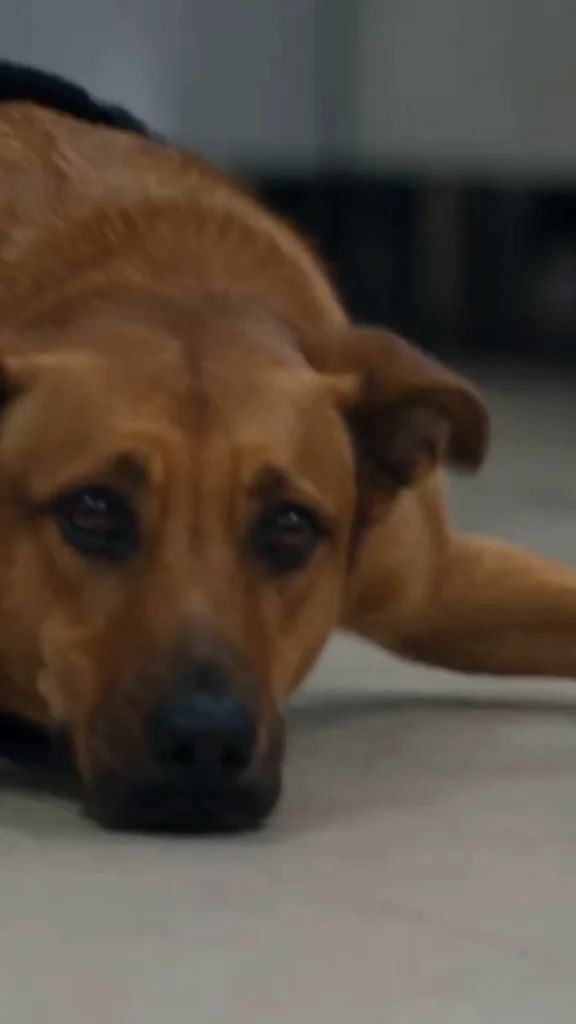
A Marine Kicked Her Three-Legged Dog—Then the Sergeant Major Recognized Her
The entire mess hall fell silent when the Sergeant Major dropped his coffee.
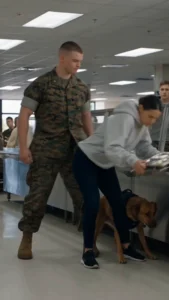
A moment earlier, a young Marine had shoved a woman into a stainless-steel counter and kicked her three-legged dog. Trays lay scattered across the floor. A few Marines stared at their boots, unwilling to get involved, while others watched in disbelief.
The dog, Bruno, lay trembling beside a fallen trash bin.
His owner knelt next to him, gently supporting his head.
“Easy, partner. I’m here.”
She carefully checked his remaining front leg. Bruno flinched, and her expression changed.
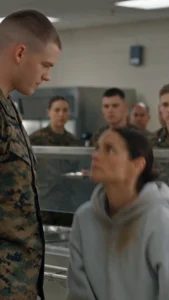
She stood and faced the Marine.
“Your boot hit his only remaining front leg.”
Corporal Tyler Mercer shrugged.
“Then he shouldn’t be in here.”
Before she could answer, the heavy doors opened.
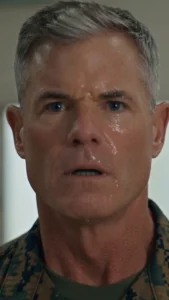
Sergeant Major Raymond Hayes entered with a coffee cup in one hand. He looked at the scattered trays, the injured dog, and the woman standing beside him.
Then he looked at her face.
The cup slipped from his fingers and shattered on the floor.
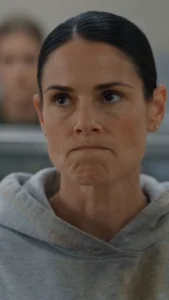
“Colonel Ward?” he whispered.
The woman gave him the smallest shake of her head.
Not yet.
Hayes swallowed his surprise and turned toward the corporal.
“What happened here?”
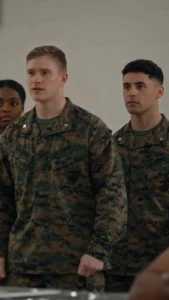
Mercer straightened his uniform.
“Sergeant Major, this civilian brought an animal into the mess hall. It caused a disturbance.”
A civilian employee stepped forward.
“That isn’t what happened. He shoved her, then kicked the dog.”
Mercer’s face hardened.
“Nobody asked you.”
Hayes looked at him with an expression that made the young Marine stop talking.
“Get the veterinary team here. Now.”
Then he turned back to the woman.
“Ma’am, can you tell me your name?”
She held his gaze.
“You already know it, Raymond.”
The Sergeant Major went completely still.
Because the woman in the faded gray hoodie was not just someone he recognized.
She was the officer who had once commanded him through the worst night of his military career.
And the three-legged dog at her feet had saved more lives than most people in that room could imagine.
Chapter 1: The Dog Everyone Underestimated
Her name was Evelyn Ward.
She had spent more than three decades serving in the military before retiring. During those years, she had led difficult operations, trained young officers, and learned that courage was often revealed in small decisions rather than dramatic speeches.
But she had not come to the installation to give a speech.
She had come to collect Bruno’s medication and enjoy a quiet morning.
Bruno had been retired for several years. He was older now, with a silvering muzzle and a scar running along one side of his face. He had lost one front leg during an overseas operation, but the injury had not taken away his determination.
He still loved long naps, disliked loud vacuum cleaners, and insisted on greeting everyone who visited Evelyn’s home.
Most importantly, he still believed that his job was to stay beside her.
Evelyn had adopted him after his retirement. Their relationship had begun with rehabilitation exercises and careful walks, but it had gradually become something deeper.
Bruno was not a symbol to her.
He was family.
The harness he wore was faded from years of use. A small metal tag hung from it, scratched and dull.
Most people saw an old dog with a missing leg.
Evelyn saw the partner who had once refused to leave an injured service member behind.
And she remembered every second of it.
Chapter 2: What Happened in the Mess Hall
The veterinary team arrived within minutes.
Evelyn stayed beside Bruno while a technician examined his injured leg. She kept her voice calm, even though her shoulder was beginning to ache from the shove.
“Can he walk?” Hayes asked.
“We need to examine him properly,” the technician replied. “Please give us room.”
Mercer folded his arms.
“This is getting ridiculous. It was an accident.”
The civilian employee shook her head.
“No, it wasn’t.”
A young Marine near the serving line finally stepped forward.
“I saw him kick Bruno.”
Mercer turned sharply.
“You want to be careful about what you’re saying.”
The young Marine hesitated, but he did not retreat.
“I know what I saw.”
One by one, other witnesses began to speak.
A cook described the shove. Another Marine confirmed that Mercer had laughed when Bruno fell. Someone else remembered hearing him call the dog useless.
The story Mercer had tried to dismiss was becoming impossible to deny.
Hayes looked at him.
“Corporal, you are going to remain here until your commanding officer arrives.”
“You can’t hold me here over a dog.”
Hayes’s expression hardened.
“This is about your conduct, your treatment of another person, and the injury to a retired military working dog. You will wait.”
For the first time, Mercer looked uncertain.
He had expected people to move out of his way.
He had not expected them to stand together.
Evelyn did not celebrate his discomfort. She was watching Bruno.
When the veterinary technician carefully lifted the dog onto a stretcher, Bruno turned his head toward her.
“I’m right here,” she whispered.
His tail moved once.
Then the team carried him toward the veterinary clinic.
Evelyn followed.
Hayes watched her leave, knowing the mess hall incident was only the beginning of a much larger problem.
Chapter 3: The Name Behind the Uniform
At the veterinary clinic, the examination revealed significant bruising and inflammation. Fortunately, the initial X-rays showed no obvious fracture.
Bruno would need rest, medication, and careful monitoring.
Evelyn finally released a breath she had been holding since the moment she heard him cry out.
Captain Naomi Brooks, the veterinarian, looked at Evelyn’s shoulder.
“You should have that examined, too.”
“It’s nothing.”
“That’s what everyone says before they discover it’s something.”
Evelyn gave her a tired smile.
“Fine. I’ll get it checked.”
When Brooks left the room, Hayes entered and quietly closed the door.
“Colonel Ward, I should have recognized what was happening sooner.”
Evelyn raised an eyebrow.
“You arrived after it started.”
“I meant the situation with Mercer. There have been complaints.”
“How many?”
“Several informal complaints. Two formal ones.”
“And what happened?”
Hayes looked uncomfortable.
“One was withdrawn. The other did not progress.”
“Why?”
He hesitated.
“Mercer’s father is Brigadier General Daniel Mercer, the installation commander.”
Evelyn stared at him.
“Are you telling me this corporal has been protected because of his father’s position?”
“I can’t say that with certainty.”
“Then investigate it. Don’t assume it. Don’t ignore it, either.”
Hayes nodded.
She continued.
“Rank cannot be an excuse for mistreating people. And it certainly cannot be an excuse for harming an animal that served this country.”
“Yes, ma’am.”
Evelyn’s expression softened slightly.
“Raymond, I retired. I did not stop believing in what we taught our Marines.”
Hayes lowered his eyes.
“I know.”
“No. I need you to remember it.”
He nodded again.
Then he asked the question he had been holding back.
“Why didn’t you tell anyone who you were?”
Evelyn glanced at Bruno.
“Because I shouldn’t need to tell people my rank to deserve basic respect.”
Hayes had no answer to that.
Chapter 4: A Photograph from Another War
Across the installation, General Daniel Mercer stood inside his office, studying a photograph he had not looked at in years.
The photograph showed a small team of service members standing outside a damaged building overseas. Beside them sat a younger Bruno, alert and muddy, his working harness covered in dust.
The image brought back a memory Daniel had tried to bury.
Years earlier, during a dangerous operation, an explosion had trapped several people inside a damaged structure. Communications had failed, and the rescue team had struggled to determine whether anyone remained inside.
Bruno had repeatedly returned toward the building despite the chaos.
Evelyn Ward had been part of the team coordinating the response.
She had insisted that the injured be accounted for before the area was cleared.
Daniel remembered the noise, the smoke, and the fear of not knowing who would come out alive.
He also remembered Bruno returning from the wreckage with a torn harness and a service member’s identification pouch caught beneath its strap.
The dog had helped rescuers locate the man.
But the operation had cost Bruno his front leg.
Afterward, Evelyn had refused to let the dog be treated as a disposable piece of equipment.
She had fought for his recovery, his rehabilitation, and eventually his retirement.
Daniel had respected her for it.
He had also respected the young Marine who had been involved in the operation and who had later become one of his most promising officers.
That memory made the latest report especially painful.
The injured dog’s name was Bruno.
The woman involved was Evelyn Ward.
And the corporal accused of kicking him was Daniel’s own son.
His office door opened.
Tyler walked in.
“Dad, I heard there’s a complaint against me.”
Daniel placed the photograph on his desk.
“Did you shove a woman in the mess hall?”
“She got in my way.”
“Did you kick her dog?”
Tyler shifted his weight.
“I barely touched it.”
Daniel looked at him for a long moment.
“That’s not what I asked.”
Tyler’s jaw tightened.
“It’s an old dog. It shouldn’t have been there.”
Daniel’s voice became quieter.
“Do you know who that dog is?”
“No.”
“His name is Bruno. He served with Marines in dangerous operations. He lost a leg while helping save a life.”
Tyler shrugged.
“Doesn’t change anything.”
Daniel closed his eyes briefly.
“No. It doesn’t.”
Tyler looked relieved.
Then his father continued.
“Because even if that dog had never served a single day, you still had no right to hurt him.”
The relief vanished from Tyler’s face.
Chapter 5: The Investigation Begins
By the afternoon, the incident had been formally reported.
Witness statements were collected. Medical findings were documented. Security footage was preserved, and the relevant command authorities were notified.
Evelyn did not demand a special punishment.
She requested a fair investigation.
That distinction mattered.
She wanted the facts established without favoritism, pressure, or shortcuts. If Mercer had broken regulations or harmed someone, the evidence should determine what happened next.
General Mercer removed himself from decisions concerning his son’s case to avoid a conflict of interest. An independent command review was requested, and investigators began examining the earlier complaints.
The results were troubling.
The first complaint had come from a junior Marine who said Tyler had repeatedly humiliated younger service members. The second involved an incident with a civilian employee.
Both complaints had stalled.
Several witnesses had been reluctant to speak because they believed nothing would change.
Now, with the mess hall incident documented and multiple witnesses willing to cooperate, the investigation had a clearer path forward.
Hayes met with the witnesses individually.
He promised that retaliation would be reported and investigated.
For the first time, some of the Marines who had remained silent began to feel that their words might matter.
Evelyn, meanwhile, stayed with Bruno.
She sat beside his bed at home, helping him adjust to the temporary restrictions on his movement. He disliked the medication, protested when she checked his bandages, and tried to follow her every time she stood up.
“You are supposed to be resting,” she told him.
Bruno looked at her as though she had personally invented the most unreasonable rule in the world.
She smiled for the first time that day.
“You haven’t changed at all, partner.”
Then her expression grew serious.
She knew the investigation could take time.
She also knew that the real test would come after the attention faded—when the people involved had to decide whether they would change their behavior even when nobody was watching.
Chapter 6: The Meeting Nobody Expected
Three days later, Evelyn received an invitation to meet with General Mercer and Sergeant Major Hayes.
She agreed, but she made one condition.
“The witnesses must be protected, and the review must remain independent.”
General Mercer accepted.
When Evelyn entered the conference room, Tyler was already seated at the far end of the table. He looked less confident than he had in the mess hall.
A copy of the incident report lay in front of him.
Daniel stood beside the window.
“Colonel Ward,” he said, “thank you for coming.”
Evelyn took her seat.
“I came because the people who witnessed this incident deserve to know that it will be handled properly.”
Daniel nodded.
“We have initiated a formal review. I have recused myself from any decision involving my son.”
Tyler looked toward his father.
“You’re really doing this?”
Daniel did not look away from Evelyn.
“Yes.”
Tyler’s face reddened.
“So you’re taking her side?”
Evelyn answered before Daniel could.
“This isn’t about sides. It’s about what happened.”
She looked directly at Tyler.
“You had a choice. You could have stepped away. You could have apologized when you realized Bruno was hurt. Instead, you mocked him and tried to intimidate the people who witnessed it.”
Tyler stared at the table.
“You don’t know what it’s like,” he muttered.
“What is it like?” Evelyn asked.
He said nothing.
“Being expected to prove yourself? Being compared with your father? Feeling that everyone is watching you?”
Tyler looked up, surprised.
Evelyn continued.
“Those things can be difficult. But they do not give you permission to hurt someone weaker than you.”
For several seconds, the room remained silent.
Then Tyler spoke.
“I didn’t think it would matter.”
Daniel’s face tightened.
“That is exactly the problem.”
Tyler looked at the photograph of Bruno that had been included in the report.
“I was wrong.”
It was not a complete apology, and Evelyn did not pretend it was enough.
“Then your actions from this point forward need to prove that you understand why.”
The meeting ended with the investigation continuing and the disciplinary process left to the proper authorities.
Nobody received an instant victory.
But the excuses had stopped.
Chapter 7: Bruno’s Choice
A week later, Bruno was walking more comfortably.
He still limped when he became tired, and Evelyn carefully followed the veterinarian’s instructions. His recovery would take patience, but he was eating well and beginning to regain his usual confidence.
One afternoon, Hayes visited Evelyn’s home to check on the dog.
He stood near the gate, holding a small bag of veterinary-approved treats.
“I brought a peace offering,” he said.
Evelyn glanced at the bag.
“Bruno accepts bribes.”
“Then I may have a chance.”
She let him in.
Bruno approached slowly, sniffed Hayes’s hand, and accepted a treat. Then he settled beside Evelyn’s chair.
Hayes watched him with a quiet smile.
“I’ve seen working dogs do remarkable things,” he said. “But I think people sometimes forget what they owe them.”
Evelyn rested a hand on Bruno’s head.
“People forget what they owe one another, too.”
Hayes nodded.
After a moment, he asked, “Do you think Mercer can change?”
Evelyn considered the question.
“I think people can change. But an apology isn’t proof. Neither is embarrassment. Change is what someone does when they no longer have an audience.”
She looked down at Bruno.
“He deserves to be safe. The witnesses deserve to be heard. And Tyler needs to understand that accountability isn’t the same as humiliation.”
Hayes thought about the young Marines who had been afraid to speak.
“You’re right.”
Evelyn smiled faintly.
“Don’t sound so surprised, Raymond.”
He laughed.
For the first time since the mess hall incident, the weight of the week seemed a little lighter.
Chapter 8: The Meaning of Service
Several weeks later, the investigation concluded that Tyler had violated conduct standards and used unnecessary force. He received formal disciplinary consequences under the applicable military process, along with mandatory professional conduct training. The earlier complaints were also reviewed, and corrective action was taken where the evidence supported it.
The findings were not announced as a spectacle.
They were documented as part of the process that should have happened from the beginning.
Daniel did not ask anyone to reduce the consequences for his son.
Instead, he attended a leadership meeting where he acknowledged that the command had failed to address earlier warning signs promptly.
He ordered a review of complaint procedures and emphasized that rank and family connections must never be allowed to silence legitimate concerns.
Not everyone was satisfied.
Some thought the consequences were too severe. Others believed the institution should have acted sooner.
But the review created a record, and the people who had spoken up were no longer left wondering whether anyone had listened.
As for Bruno, he returned gradually to his familiar routine.
His remaining front leg healed, his appetite improved, and his enthusiasm for visitors remained unchanged.
One sunny afternoon, Evelyn brought him to a quiet outdoor area near the installation’s memorial garden. Hayes was there, along with several Marines who had witnessed the mess hall incident.
They had come not to celebrate the punishment of one man, but to recognize the service of the people and animals who had protected others.
A small plaque had been prepared to honor retired military working dogs.
Evelyn read the inscription quietly.
It spoke of loyalty, courage, and the silent work performed by animals whose names rarely appeared in headlines.
She knelt beside Bruno.
“You hear that, partner? They’re finally giving you the recognition you deserve.”
Bruno sniffed the edge of the plaque, then looked up at her.
Hayes chuckled.
“He seems unimpressed.”
“He prefers treats.”
A few people laughed.
The moment was simple, and that was what made it meaningful.
No grand speech could return Bruno’s lost leg. No official ceremony could erase the pain of the incident. And no disciplinary action could guarantee that every future complaint would be handled perfectly.
But the people standing there had a choice.
They could treat the incident as an embarrassing story that would eventually disappear.
Or they could learn from it.
They chose to remember.
Chapter 9: The Apology
Several months later, Evelyn received a letter from Tyler.
She read it at her kitchen table while Bruno slept beside her chair.
The letter was brief.
Tyler did not ask her to withdraw the complaint. He did not blame his stress, his upbringing, or his father’s rank. He admitted that he had treated Bruno as though the dog’s disability made him less worthy of respect.
He also admitted that he had tried to intimidate the witnesses because he feared the consequences.
At the end, he wrote that he did not expect forgiveness.
He only wanted to acknowledge what he had done.
Evelyn read the letter twice.
Then she placed it in a drawer.
She was not required to answer.
An apology did not erase the injury, and forgiveness was not something another person could demand.
But she recognized a difference between a man who wanted to escape consequences and one who was beginning to accept responsibility.
A few days later, she sent a short reply.
She told Tyler that Bruno was recovering well. She told him that taking responsibility was only the first step. The real work would be to treat people with dignity when there was no reward for doing so.
She ended with one sentence:
“Become the kind of Marine who would protect someone even when nobody important is watching.”
She signed her name and mailed the letter.
Then she returned to the garden, where Bruno was waiting for his afternoon walk.
Chapter 10: The Dog Who Never Needed a Rank
On a clear morning, Evelyn and Bruno visited the memorial garden again.
Hayes was there, talking with a group of younger Marines about military working dogs and the responsibilities that came with service.
When he saw Bruno, he stepped aside to make room.
One of the youngest Marines crouched nearby.
“Can I say hello to him?”
Evelyn nodded.
The Marine approached slowly, allowing Bruno to sniff his hand first. Bruno accepted the greeting and leaned gently against the young man’s knee.
“He’s amazing,” the Marine said.
Evelyn smiled.
“He’s also stubborn, impatient, and convinced that every meal should contain chicken.”
The young Marine laughed.
Then he looked at Bruno’s missing leg.
“Does he ever get upset about it?”
Evelyn thought for a moment.
“I don’t know what he thinks about it. But I know he doesn’t believe his life is over because something changed.”
She stroked the fur behind his ears.
“He still wants to walk. He still wants to explore. He still wants to be near the people he trusts.”
The Marine nodded, taking the answer seriously.
Hayes watched from a few feet away.
He remembered the mess hall: the scattered trays, the cruel laughter, the woman nobody recognized, and the dog who had been treated as though his disability made him worthless.
Now he understood the lesson more clearly.
Service was not measured by physical perfection.
Honor was not determined by rank.
And courage did not always look like a soldier charging toward danger.
Sometimes it looked like a person kneeling beside an injured animal when everyone else was afraid to intervene.
Sometimes it looked like a witness speaking up.
Sometimes it looked like a leader admitting that a system had failed.
And sometimes it looked like an old dog, standing on three legs, trusting the world enough to accept a gentle hand.
Evelyn clipped Bruno’s leash to his harness.
“Ready, partner?”
Bruno stood.
His tail moved.
Together, they started down the path.
Hayes watched them go, then turned to the young Marines.
“Remember something,” he said. “You don’t measure a person’s character by how they treat someone who can help them. You measure it by how they treat someone who cannot fight back.”
The Marines fell quiet.
In the distance, Evelyn and Bruno continued toward the sunlight.
She had never needed the corporal to know her rank.
She had never needed the entire mess hall to applaud her.
She had only needed Bruno to be safe.
And in the end, that was what mattered.
The Marine had seen a disabled dog and believed he was looking at weakness. The Sergeant Major saw a veteran, a partner, and a reminder of what service was supposed to mean.
Bruno had lost a leg while serving others.
He had never lost his worth.
The End.
A Note for Readers
This story is a work of fictional military drama inspired by the supplied video scene. It is intended to highlight compassion, accountability, and respect for retired military working dogs and the people who serve alongside them.