The Navy Buried His Name for 24 Years—Then His Son Called Him Dad
The Navy Buried His Name for 24 Years—Then His Son Called Him Dad
“Dad?”
Lucas Carter’s voice was barely audible, yet it carried across the silent graduation plaza.
For twenty-four years, he had imagined what he might say if his father ever returned. Sometimes, in childhood, he had pictured running into his arms. As a teenager, he had imagined demanding an explanation. As a young man, he had promised himself that if they ever met again, he would remain calm.
But now the man stood only a few feet away.
And Lucas could not move.
Michael Carter looked at his son as if the entire world had narrowed to that single face.
He had imagined this moment countless times during the years he spent away. He had rehearsed explanations in his mind, apologies in the darkness, and conversations that would begin with the words he had never been able to send home.
Now every prepared sentence had disappeared.
“Lucas,” he whispered.
The young ensign took one uncertain step forward.
“It’s really you?”
Michael nodded, but the movement seemed to cost him everything.
“Yes, son.”
Lucas looked toward Admiral Richard Callahan, searching for an explanation that might make the impossible easier to believe.
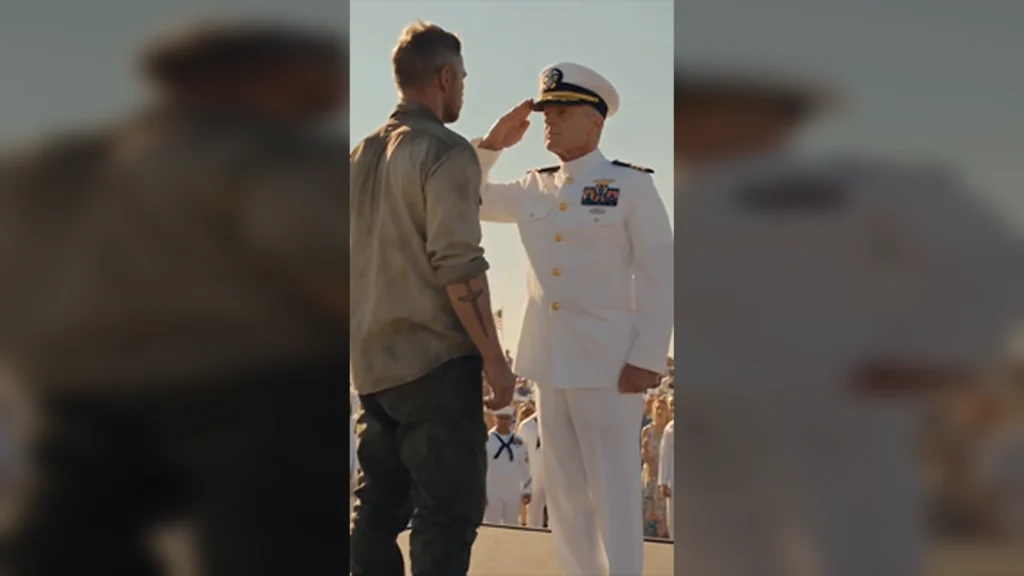
The admiral stood at attention, his hand still raised in salute.
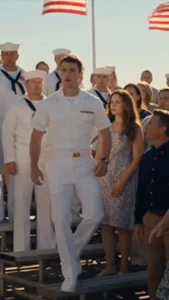
Around them, thousands of guests watched without understanding how a routine graduation ceremony had become something no official program could have predicted.
Then Lucas looked back at the man he had spent most of his life believing was dead.
And he asked the question that had followed him since childhood.
“Where have you been?”
Michael lowered his eyes.
“That,” he said, “is the story I owe you.”
Chapter 1: The Father Who Never Came Home
Lucas had been five years old when his father disappeared.
He remembered fragments rather than a complete picture: a uniform hanging beside the front door, the smell of coffee in the kitchen, and a strong hand lifting him onto a pair of broad shoulders.
His father had been the kind of man who fixed things before anyone noticed they were broken. He repaired the kitchen cabinet, sharpened garden tools, and always checked the locks before going to bed.
Most importantly, he had promised to return.
Then came the official notification.
Commander Michael Carter had been reported lost at sea following a classified naval operation in the South China Sea. The circumstances were restricted, and the Navy could provide little information beyond the conclusion that he had not survived.
Lucas’s mother, Elena, received the news in a quiet office from two officers who struggled to look her in the eye.
She asked whether they had found his body.
They had not.
She asked whether there was any chance he was alive.
They could not offer one.
The years that followed changed their household. Elena learned how to answer difficult questions without having the answers. She learned how to celebrate birthdays while leaving space for someone who would never walk through the door.
Lucas learned to stop asking when his father would return.
At school, other children spoke about their fathers at dinner tables and sporting events. Lucas sometimes invented small details to avoid explaining why his own father was absent.
When he grew older, he joined the Navy.
Some people assumed it was an attempt to follow a family tradition. Others believed he wanted to discover what had happened to Michael.
The truth was more complicated.
Lucas wanted to become a man his father would have respected. He wanted to understand the world that had taken Michael away. And, although he rarely admitted it, a part of him hoped that wearing the same uniform might bring him closer to the answers.
He never expected to find those answers at his own graduation.
Chapter 2: The Admiral’s Unfinished Promise
Admiral Richard Callahan had carried the memory of Commander Michael Carter for twenty-four years.
During the operation in the South China Sea, Callahan had been a younger officer serving alongside Carter and a small team assigned to a mission that was never meant to appear in public records.
Their vessel suffered catastrophic damage during a violent encounter. Water flooded lower compartments, electrical systems failed, and the team found its escape route blocked by a damaged pressure mechanism.
They had minutes.
Carter assessed the situation and understood what the others did not want to accept: someone had to remain behind long enough to operate the failing mechanism manually.
He ordered the team toward the exit.
Callahan protested.
“You’re coming with us,” he insisted.
Carter shook his head.
“Not unless that mechanism moves.”
“We can find another way.”
“Then find it quickly.”
But there was no other way—not in the time they had left.
Carter pushed Callahan toward the passage and returned to the control assembly.
The last thing Callahan remembered was Carter’s expression through the narrowing opening.
It was not fear.
It was determination.
Then the passage closed.
Callahan survived with the rest of the team. Carter did not emerge.
The subsequent report classified the details of the operation. Carter was officially listed as lost at sea, and the surviving personnel were ordered to protect information that could not be publicly discussed.
Callahan obeyed.
For years, he told himself that the restrictions were necessary. He advanced through the ranks, accepted new responsibilities, and attended ceremonies honoring sailors whose sacrifices had been formally recognized.
Yet every time he saw a family waiting for someone who would never return, he remembered the man he had left behind.
He had tried to learn whether Carter’s family received the support they deserved. The answers came through official channels, incomplete and delayed.
He knew Carter had a young son.
He knew the boy would grow up without his father.
And he knew no medal could repair that absence.
When Callahan noticed the faded Ghost Trident tattoo on the stranger’s arm at Seaview Naval Academy, the past returned with terrifying clarity.
Only a handful of people had carried that symbol.
One of them had saved his life.
The man in the last row had Carter’s face.
Chapter 3: A Son’s Anger
Lucas took another step toward Michael.
The crowd remained silent. Even the photographers lowered their cameras, sensing that the moment belonged to the people standing before them.
“Everyone told me you were dead,” Lucas said.
Michael nodded.
“I know.”
“Mom waited for you.”
The words struck harder than any accusation could have.
“I know.”
“She kept your room the same for years. She thought maybe you’d come back.”
Michael’s eyes filled with tears.
“I should have been there.”
Lucas shook his head, struggling to control his voice.
“You don’t get to say that as if it’s simple. I grew up without you. I watched Mom pretend she was fine. I learned how to answer questions about a father I couldn’t remember properly.”
Michael did not interrupt.
He had spent years preparing to defend his choices, but standing before his son, he understood that no explanation could erase the childhood Lucas had lost.
Finally, Lucas asked, “Why didn’t you come home?”
Michael looked toward the admiral.
Callahan lowered his hand and stepped closer.
“Lucas, there are things about your father’s disappearance that were never properly explained to your family. I cannot promise that every part of the story can be discussed publicly, but I can promise that we will not ask you to accept another incomplete answer.”
Lucas turned back to Michael.
“Then tell me what you can.”
Michael took a breath.
“After the passage closed, I was trapped in a damaged compartment. The pressure changed, the lights went out, and I lost consciousness. When I woke, I was no longer aboard our vessel.”
He paused.
“Another team had found me. I was seriously injured, and the circumstances of the operation made an immediate return impossible.”
“Impossible for twenty-four years?” Lucas asked.
“No,” Michael replied quietly. “Not every year was impossible. Some decisions were made for reasons I believed I had to accept. Some were made because I was afraid that returning would expose people who had helped me survive. And some were mistakes I should have challenged sooner.”
It was not the clean, heroic explanation Lucas might have expected.
It was worse in some ways: a story of survival mixed with fear, duty, and decisions that had caused lasting pain.
“Did you try to find us?” Lucas asked.
“Yes.”
“Did you write?”
Michael’s silence answered before his words did.
“Not enough. Not when I should have. I thought I was protecting you. I told myself that waiting was safer than bringing the past into your lives.”
Lucas’s expression hardened.
“You made that decision for us.”
“Yes,” Michael admitted. “I did.”
For the first time, Lucas saw his father not as a legend, a victim, or a mystery, but as a man who had survived something terrible and then failed his family in ways that survival could not excuse.
That truth hurt.
But it was a truth.
Chapter 4: The File That Was Never Meant to Be Opened
Admiral Callahan requested that the graduation’s senior officers arrange a private room for Michael, Lucas, and the appropriate officials.
He did not want the most important conversation of their lives to become a public spectacle.
Before they left the plaza, however, he addressed the assembled guests.
“Today, we came here to celebrate the men and women who have earned their commissions,” he said. “But we have also been reminded that service carries obligations beyond the ceremony. We owe honesty to our people, respect to their families, and accountability when our institutions fail them.”
He did not reveal classified operational details. He did not announce a complete resolution before one existed.
Instead, he promised a formal review of the circumstances surrounding Michael’s disappearance and the handling of the information given to his family.
Inside the private room, a senior legal officer explained that Michael’s identity and account would need to be verified. The Navy could not simply rewrite official records because an emotional reunion had occurred.
Michael agreed.
“I am not asking you to accept my word without evidence,” he said. “I want the record examined properly.”
He provided details that only members of the original team could have known: the location of a damaged control panel, a phrase used during the evacuation, and the names of personnel whose involvement had never been publicly acknowledged.
Callahan independently confirmed parts of the account.
The review would take time, but for the first time in decades, the questions were being examined rather than dismissed.
Lucas sat across from his father, listening.
He wanted to believe him. He also knew that belief could not be demanded as a favor.
“I’m glad you’re alive,” Lucas said eventually. “But I don’t know what I’m supposed to do with everything else.”
Michael nodded.
“You don’t have to decide today.”
“You missed my whole childhood.”
“I know.”
“You missed Mom’s hardest years.”
“I know.”
“And now you expect me to call you Dad?”
“No,” Michael said. “I hope you’ll want to someday. But I have no right to demand it.”
That answer did not heal Lucas’s anger.
It did, however, give him room to feel it without being told that he was wrong.
Chapter 5: The Woman Who Had Kept Waiting
Lucas called his mother that evening.
Elena answered from the kitchen, where she had been preparing dinner. She asked how the graduation had gone, expecting to hear about the ceremony, the speeches, and the photographs she had not been able to attend in person.
Instead, Lucas said, “Mom, I need you to sit down.”
Her voice changed immediately.
“Lucas? What’s happened?”
“Nothing happened to me. I’m safe.”
“Then what is it?”
He struggled to speak.
“Dad is alive.”
The silence on the other end of the line lasted so long that he checked whether the call had disconnected.
Then he heard his mother’s breath catch.
“Don’t say that unless you’re certain.”
“I saw him. I spoke to him. The admiral knows him. They’re reviewing everything.”
Elena sat down at the kitchen table.
For years, she had imagined what she might feel if someone told her Michael was alive. She had pictured relief, anger, disbelief, and joy.
Now those emotions arrived together, too tangled for her to separate.
“Did he ask about us?” she whispered.
“Yes.”
“What did he say?”
Lucas looked through the window at the darkening sky.
“He said he was sorry.”
Elena closed her eyes.
It was the sentence she had wanted to hear for years, but it could not restore the birthdays, the school events, or the ordinary evenings when she had needed someone to share the burden.
“Does he want to come home?” she asked.
“He wants to talk to you. But he says you don’t owe him anything.”
Elena remained silent for a moment.
Then she said, “He’s right about that.”
Lucas waited.
“I need time,” she continued. “I spent a long time learning how to live without him. I cannot return to the person I was before simply because he has come back.”
“I understand, Mom.”
“Do you hate him?”
Lucas thought about the man standing in the sunlight, the tears on his face, and the admission that he had made decisions for the family without asking them.
“No,” he said. “But I’m angry.”
“You’re allowed to be.”
For the first time that day, Lucas felt that he did not have to choose between loving his father and acknowledging what his absence had done.
Both could be true.
Chapter 6: The Truth Behind the Ghost Trident
The formal review uncovered a complicated history.
Michael had survived the original incident, but his injuries were severe. He was recovered by personnel working under a separate operation and transferred through a chain of medical facilities while his identity was protected.
Some records had been sealed for legitimate operational reasons. Others had been handled poorly as personnel changed and the original mission receded into the past.
No single document explained every year of Michael’s absence.
His recovery had been real. So had the confusion, fear, and isolation that followed it.
At first, he believed he would be able to contact his family once the immediate restrictions were lifted. Later, he became entangled in a series of assignments and security decisions that kept delaying the moment he could return.
But the review also established something important: the system had treated his disappearance as a closed case without adequately ensuring that his family’s questions had been addressed.
Callahan was troubled by the findings.
“I signed reports based on what I was given,” he told the review panel. “But I should have kept asking questions.”
He did not try to excuse his part in the failure.
Michael, too, had to face the consequences of his decisions. His survival did not make every choice afterward correct. He had allowed years to pass without finding a way to give his family the truth.
The review recommended corrections to the record, an examination of the communication failures, and a formal acknowledgment of the impact on Elena and Lucas.
It also confirmed Michael’s service and the actions he had taken during the original operation.
The Ghost Trident was no longer merely a symbol that connected a stranger to a forgotten mission. It became evidence that the past could be examined honestly, even when the truth was complicated and painful.
For Callahan, the process was not about winning recognition for an old friend.
It was about ensuring that Michael’s family would no longer be left with a story that began with a promise and ended with silence.
Chapter 7: A Father’s First Promise
Michael did not return to Elena’s home immediately.
He waited until she agreed to meet him.
When the day came, he stood outside the front door with empty hands. He had considered bringing flowers, photographs, and gifts for the years he had missed. Eventually, he realized that none of them could substitute for the conversation they needed to have.
Elena opened the door.
For a moment, neither spoke.
Michael looked older than the man she remembered. His hair had thinned, his face carried deep lines, and the years had changed the way he stood.
But his eyes were familiar.
“You’re alive,” she said.
“Yes.”
“I spent years wondering whether I should keep hoping.”
Michael lowered his head.
“I am sorry.”
She stepped aside and let him enter.
They sat at the kitchen table where Lucas had once done his homework. The room seemed smaller than Michael remembered. The cabinet he had repaired was still there, though someone had replaced the handle.
Elena asked him questions, and he answered as honestly as he could. When he did not know an answer, he said so. When he could not discuss a detail, he explained that limitation rather than hiding behind vague reassurances.
She did not forgive him that afternoon.
But she listened.
Before he left, Michael looked toward the hallway where Lucas’s childhood photographs still hung.
“I want to be part of his life,” he said.
“Then understand that you cannot walk back into it as if nothing happened.”
“I understand.”
“No, Michael. You are beginning to understand. The rest will take time.”
He nodded.
“I will wait.”
Elena studied him.
“You have already made us wait long enough. If you want a place in our lives, you must be present. Not just when the past becomes painful. Not just when you feel guilty. You must show up on ordinary days, too.”
Michael felt the truth of those words more deeply than any reprimand from a superior officer.
“I will,” he said.
This time, he made no grand promise about forever.
He promised to call the next day.
And the day after that.
And to keep doing what he said he would do.
Chapter 8: The Graduation Photograph
A few weeks later, Lucas received the official photograph from his graduation.
He had expected a picture of himself in a spotless white uniform, standing among the newest Navy officers.
Instead, the image that mattered most was one taken after the ceremony.
Lucas stood between Admiral Callahan and Michael Carter. The admiral wore his formal uniform. Michael wore a simple jacket and the same battered boots he had worn to the academy.
Lucas had not asked for the photograph to be staged.
He had simply looked at his father and said, “Stand here.”
Michael had hesitated.
“Are you sure?”
“No,” Lucas answered honestly. “But I want to remember today.”
They stood together.
When the photographer counted down, Lucas placed one hand on his father’s shoulder. The gesture was small, and it did not mean that every wound had healed.
It meant that Lucas was willing to begin.
Later that evening, he called Michael.
“Dad?”
Michael went quiet on the other end of the line.
“Yes, son?”
“I was thinking about the photograph.”
“I like it.”
“You look terrible in it.”
Michael laughed—a surprised, genuine laugh that made him sound briefly like the man Lucas had remembered from childhood.
“I’ve been told.”
Lucas smiled.
Then his voice grew serious.
“We still have a lot to talk about.”
“I know.”
“And I’m not promising everything will be okay.”
“I wouldn’t ask you to.”
Lucas looked at the photograph resting on his desk.
“Good. Then we’ll start with tomorrow.”
Michael swallowed hard.
“Tomorrow it is.”
For the first time in twenty-four years, the future did not feel like a door closing.
It felt like one opening, slowly, with both men standing on the same side.
Conclusion: The Man the Navy Buried
Admiral Richard Callahan had spent decades believing that honoring Michael Carter meant remembering the sacrifice he had made during the South China Sea operation.
He eventually understood that remembrance was only the beginning.
A hero’s name could be placed in a report, engraved on a memorial, or spoken during a ceremony. But none of those acts could replace the years a family had spent living with unanswered questions.
Michael Carter had survived the sea, but survival had not spared him from responsibility.
Lucas Carter had grown into an officer without his father, but he did not have to pretend that the absence had left no scars.
Elena had learned to live without the man she loved, and she had the right to decide what place he might have in her life again.
Their reunion was not a magical ending in which every wound disappeared.
It was something more honest.
It was the beginning of a difficult conversation, the reopening of a buried record, and the possibility that trust could be rebuilt through actions rather than promises.
At the next Navy ceremony, Admiral Callahan stood before a room of young officers and spoke about courage.
He told them that courage was not always found in combat, and sacrifice was not always visible to the public. Sometimes courage meant admitting a mistake. Sometimes honor meant asking a difficult question. And sometimes the most important duty was to remember that behind every missing name was a family still waiting for the truth.
He did not tell the room that every institution always gets it right.
He told them that institutions must be willing to correct themselves.
And he reminded them that a uniform was not a substitute for character.
Michael Carter had once stayed behind so others could escape a sinking ship. Twenty-four years later, his return gave his family a chance to face the truth he had left behind.
The sea had not taken everything from him.
But the years had taken enough.
Now, at last, he had the opportunity to do something that medals could never accomplish.
He could be a father again—one ordinary day at a time.
Because sometimes the most powerful salute is not the one given to a hero in public. It is the quiet act of showing up for the people who thought they had lost you forever.
This story is a fictional military drama created for storytelling and entertainment. Characters and events are fictionalized.