Two F-22 Raptors Intercepted Her Plane — Then She Spoke Three Words
Two F-22 Raptors Intercepted Her Plane — Then She Spoke Three Words
Chapter 1: The Call Sign Nobody Was Supposed to Remember
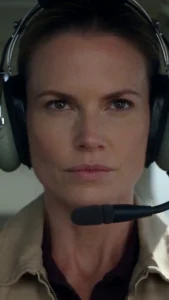
The pilot’s question hung in my headset.
“Wait… who… who did you say you were?”
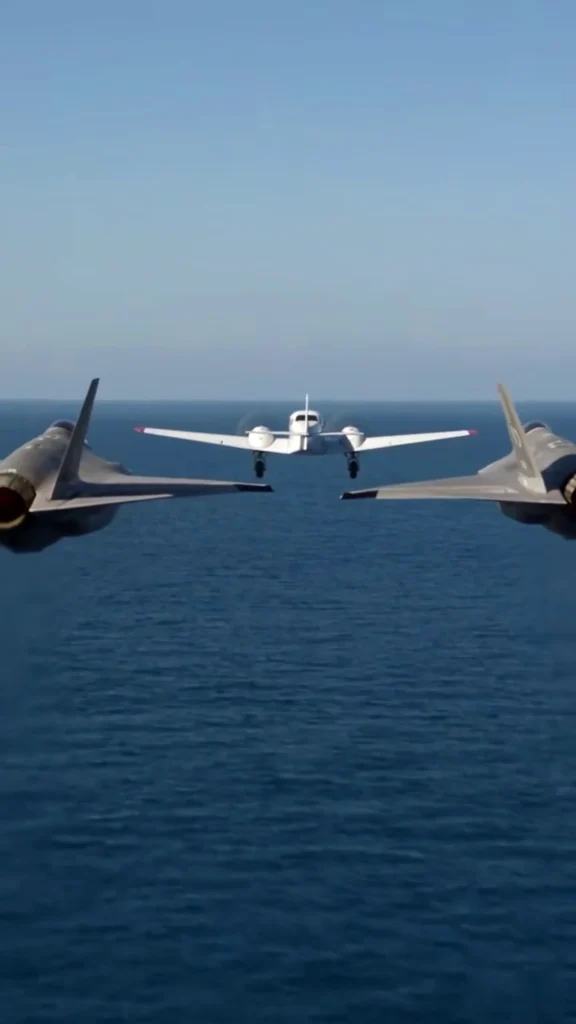
I kept the Cessna level while two F-22 Raptors held position on either side of me.
“My call sign is Echo Actual,” I repeated. “Requesting immediate identification of the commanding officer responsible for this intercept.”
Silence.
Then a different voice entered the channel.
“Echo Actual, this is Strike Command. Authenticate.”
I entered a short sequence on the concealed transceiver. It was an old procedure, one I had hoped never to use again.
The response came almost immediately.
“Authentication received.”
A pause followed.
Then the voice returned, no longer casual or procedural.
“Stand by. Do not change course. Maintain your present altitude if safe to do so.”
The two Raptors began moving away from my wingtips, increasing their separation without making any sudden movements. Their weapons-bay doors were no longer visibly open.
I watched the left fighter through the window.
Its pilot was still looking at me.
He had been ordered to intercept an unidentified civilian aircraft. Now he was trying to understand why that aircraft had just connected to a secure military channel using a call sign he had never expected to hear.
I had no intention of explaining my entire history over an open frequency.
Five years earlier, I had disappeared in Afghanistan after a helicopter carrying members of a covert team crashed in mountainous terrain. The official report declared me dead after recovery operations failed.
The report had been necessary for reasons that had nothing to do with the life I had wanted.
But the name Sarah had never stopped being mine.
“Echo Actual,” Strike Command transmitted, “please confirm your current identity.”
I looked down at the Atlantic.
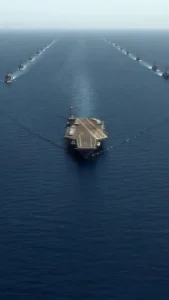
The carrier strike group spread beneath me like a floating city of steel. Destroyers and cruisers held their positions around the enormous carrier, their wakes drawing pale lines across the blue water.
“My identity is Sarah,” I replied. “I need to speak directly with the officer in tactical command.”
The answer came after a brief pause.
“Understood. The admiral is coming on the line.”
That was when I realized the two fighters were no longer the biggest problem.
Someone aboard that carrier had recognized my call sign.
And whoever it was had gone very quiet.
Chapter 2: Admiral’s Recognition
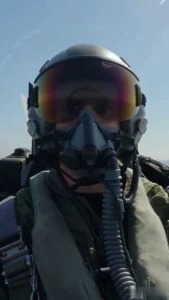
“Echo Actual, this is Rear Admiral Thomas Whitaker.”
I knew the name.
Whitaker had been a senior operations officer during one of the missions I had supported years earlier. He was not someone who forgot a voice, a call sign, or a failed operation.
“Admiral,” I answered.
“Sarah?”
For the first time since the intercept began, I heard something personal in a voice coming through a secure military channel.
“Yes, sir.”
There was a long silence.
“Your personnel file says you died five years ago.”
“I am aware of the file.”
“Do you understand the situation you’re creating by appearing inside this exercise?”
“I understand that I was intercepted, sir. I also understand that I was not given any public notice of the restricted airspace before entering it.”
“We’re reviewing that now.”
His tone hardened.
“First, I need to know whether you are in distress, whether the aircraft is damaged, and whether anyone else is aboard.”
“I’m alone. Both engines are operating normally. The aircraft remains controllable.”
“Good. Follow the lead fighter to a safe holding area. Do not attempt to approach the carrier.”
“Understood.”
The admiral lowered his voice.
“Sarah, I’m going to ask you something, and I need a straight answer. Why are you using that call sign?”
I looked at the old panel beneath my seat.
Because I had been trained to use it. Because the equipment had survived. Because some part of me had never fully accepted the ending written into an official report.
But none of those answers explained why I was here.
“I activated it because the fighters were threatening to use force against my aircraft, sir. I needed to reach a command authority that could verify who I was.”
“Fair enough.”
A new voice interrupted.
“Admiral, we have an additional problem.”
Whitaker answered immediately.
“Go ahead.”
“The intercept team reports an anomaly in the airspace record. The civilian flight plan appears valid, but the exercise restriction was not distributed consistently across the relevant civilian channels.”
I closed my eyes for a moment.
That explained how I could have filed a normal flight plan and still entered the exercise area.
It did not explain why the fighters had moved so quickly to an aggressive intercept.
Whitaker returned to the channel.
“Sarah, we are going to bring you to a safe landing site. After that, I need you to remain available for a formal debrief.”
“Understood, Admiral.”
“One more thing.”
“Yes, sir?”
“Do not assume that because I recognize your call sign, I know why you’re here.”
“I wouldn’t dream of it.”
For the first time, a faint trace of the old Whitaker appeared in his voice.
“Still have that answer for everything, I see.”
Then the secure channel closed.
Chapter 3: The Landing Nobody Expected
The lead Raptor guided me toward a military airfield on the Virginia coast.
I kept my hands steady on the controls and followed the instructions transmitted through the radio. The fighters maintained a professional escort distance, no longer crowding the Cessna’s wings.
My heart was still beating faster than I wanted to admit.
The aircraft was old, but it had been maintained carefully. Its engines sounded healthy, the instruments remained stable, and I had no intention of taking unnecessary risks just because an extraordinary situation had developed around me.
As the coastline appeared, a new voice entered the frequency.
“Echo Actual, this is tower. We have you in sight. Continue inbound as instructed.”
I acknowledged and completed the approach.
When the wheels finally touched the runway, the aircraft bounced once before settling. I eased the throttles back and guided it toward the designated parking area.
Several military vehicles were waiting nearby.
I shut down the engines.
For a few seconds, I remained seated, listening to the ticking metal and the fading silence that followed the flight.
Then I removed my headset.
The canopy opened, and a ground crew member approached cautiously.
“Ma’am, please remain in the aircraft until the security team arrives.”
“Understood.”
I wasn’t offended. An unknown aircraft had entered a classified exercise area, and a secure military radio network had just authenticated a call sign associated with a person officially declared dead.
Questions were inevitable.
Within minutes, two officers arrived. One introduced himself as Commander Ellis, the security liaison assigned to the incident.
“Sarah, we need to verify your identity and secure the aircraft’s communications equipment.”
“You may verify my identity through the appropriate channels,” I replied. “But I want the equipment documented before anyone removes it.”
Ellis studied me.
“That’s reasonable.”
He directed a technician to photograph the panel and record its condition before it was disconnected.
I appreciated the decision.
The last thing I wanted was for a genuine aviation incident to turn into a contest over who held authority.
As the technicians worked, Ellis handed me a bottle of water.
“Admiral Whitaker is waiting for you.”
“Then I imagine I shouldn’t keep him waiting.”
For the first time that morning, I allowed myself a small smile.
The sky above the airfield was calm and blue.
From the ground, the two Raptors looked almost ordinary.
Almost.
Chapter 4: The File Marked Closed
The debriefing room was smaller than I expected.
Rear Admiral Whitaker sat at one end of the table with two officers from the security and operations teams. A thick folder lay in front of him.
My name was printed on its cover.
Beneath it were two words.
CASE CLOSED.
Whitaker noticed me looking.
“That file was closed because the evidence available at the time supported the conclusion that you had not survived the crash.”
“I know.”
“We searched for weeks. We interviewed everyone who returned. We reviewed the available records.”
“I know that too, sir.”
He gestured toward a chair.
“Sit down, Sarah.”
I did.
“Tell us what happened after the crash.”
I took a slow breath.
The helicopter had gone down in mountainous terrain during a mission that was never intended to appear in public records. I had survived the initial impact, but I was separated from the rest of the team. Communications were damaged, the terrain was dangerous, and the recovery effort did not locate me.
I eventually reached safety through circumstances that were too complicated to summarize in a few sentences.
Afterward, I had faced a choice.
Return immediately to a life in which every detail of the mission would be examined, or step away while the authorities determined what could be disclosed and what had to remain protected.
I had stepped away.
The decision had consequences. The official record did not tell the whole story, and my civilian identity had become the life I used every day.
“I wasn’t trying to interfere with your exercise,” I said. “I was flying a properly planned civilian route. I didn’t know the area had been restricted.”
One of the operations officers opened a document.
“Our preliminary review supports part of that account. The airspace coordination records are incomplete.”
“Then the intercept wasn’t caused by deliberate interference from my aircraft.”
“We have found no evidence of that,” the officer replied. “But the review is ongoing.”
Whitaker folded his hands.
“Your call sign is recognized by a small number of people. It should not have been possible for an ordinary intercept to escalate without an authentication check.”
“Yet it did.”
“Yes.”
He looked at the folder.
“And that’s why this incident matters.”
Chapter 5: The Question Behind the Intercept
The next hour was spent reconstructing the flight.
Investigators examined the filed route, the aircraft’s transponder records, the available communications, and the sequence of commands given by the intercept team.
The evidence suggested that the pilots had been responding to what they believed was an unauthorized aircraft inside a restricted area. They had not known who I was, and they had been following instructions based on the information available to them.
The problem was that the information had been incomplete.
The airspace restriction had not been coordinated as cleanly as it should have been. The intercept had escalated before the command structure had confirmed the full picture.
No one in the room claimed that a classified exercise made civilian safety irrelevant.
Whitaker was especially clear about that.
“A restricted zone is not a substitute for sound coordination,” he said. “And an intercept is not a license to stop thinking.”
The lead Raptor pilot joined the debrief by secure video.
He looked younger than I had expected.
“Ma’am,” he said, “I followed the instructions we received. We believed your aircraft was entering a protected operating area.”
“I understand,” I replied.
He hesitated.
“When you transmitted your call sign, I thought it was a prank. Then the authentication came back.”
“I imagine that was surprising.”
“Yes, ma’am.”
He looked uncomfortable.
“I also want to apologize for how aggressive the intercept became. We were prepared to escalate before we had established the complete situation.”
I appreciated the honesty.
“You were working with the information you had,” I told him. “The important thing is that the system learns from what happened.”
Whitaker nodded.
“That is exactly what the review will address.”
But there was still one question no one had answered.
Why had the old authentication system remained active?
The equipment in my Cessna had been installed years earlier, and I had not used it since leaving military service. Yet the network had recognized it immediately.
A communications specialist brought up the technical records.
“The credentials remain valid in an archived authentication environment,” he explained. “They should have triggered a manual verification process before any further action was taken.”
“Should have,” Whitaker repeated.
The specialist nodded.
“Yes, sir.”
The admiral looked at me.
“Sarah, your appearance exposed a weakness in our process. That does not mean you caused the weakness.”
I leaned back.
“For what it’s worth, Admiral, I would prefer never to expose it again.”
“That makes two of us.”
Chapter 6: The Mission That Wasn’t a Mission
By the following morning, the initial incident report had been completed.
The findings were not dramatic. There was no secret enemy aircraft hiding behind the clouds and no evidence that the carrier group had been deliberately targeted.
Instead, there was a series of ordinary mistakes with extraordinary potential consequences: incomplete coordination, an outdated authentication process, and an intercept that escalated before the relevant information had been verified.
The exercise was paused while the appropriate authorities reviewed the procedures.
The two F-22 pilots were interviewed, and the airspace coordination process was examined. The purpose was not to find a convenient person to blame but to establish how the incident had developed and how to prevent a repeat.
I was asked to remain available while my identity and the status of the archived credentials were reviewed.
During a break, Whitaker found me near a window overlooking the airfield.
“You could have told us who you were much earlier,” he said.
“I could have. But the fighters had ordered me to descend and were threatening to use force. I needed the command authority to verify the situation.”
He considered that.
“Fair answer.”
I watched a maintenance crew moving equipment near the runway.
“Admiral, what happens to the file now?”
He looked toward the folder under his arm.
“It will be updated. The record of your death will be reviewed through the appropriate channels. Any change has to be supported by evidence and handled correctly.”
“And the call sign?”
“The authentication credentials will be secured until the review determines what should happen to them.”
I nodded.
I had expected to spend the day defending my presence in the sky.
Instead, I had helped uncover a problem that needed fixing.
That didn’t make the morning pleasant, but it gave the incident a purpose beyond the fear it had caused.
Chapter 7: The Woman Who Came Back
Two days later, I returned to my Cessna.
The technicians had completed their initial inspection, and the aircraft was cleared for its next steps under the applicable procedures. My flight would resume only after the necessary permissions and coordination had been confirmed.
Before I left the base, Whitaker asked to speak with me one final time.
“We have a decision to make about your status,” he said. “Your identity has been verified, and the initial review supports your account of the flight. The remaining administrative questions will take longer.”
“I understand.”
He paused.
“Do you intend to return to military service?”
I looked out toward the runway.
Five years earlier, I had believed that my life had ended in those mountains. I had learned to build a quieter existence around the pieces that remained.
The thought of returning was complicated.
“I don’t know yet, sir.”
Whitaker nodded.
“That’s an honest answer.”
“I have a life outside this. I don’t want to make a decision because of one frightening morning.”
“Nor should you.”
He offered his hand.
“Whatever you decide, I hope you understand that you did the right thing by staying calm and communicating when you were intercepted.”
I shook his hand.
“Thank you, Admiral.”
When I walked toward the aircraft, I noticed one of the Raptor pilots standing near the hangar.
He gave me a respectful nod.
I returned it.
There was no dramatic salute, no applause, and no announcement that I had changed the course of military history.
There didn’t need to be.
The important thing was that everyone involved had survived the encounter, the investigation had begun, and the procedures that failed that morning were being examined.
I climbed into the Cessna and settled into the seat.
The cockpit smelled familiar: warm metal, old upholstery, and the faint trace of aviation fuel. I checked the instruments and waited for the clearance that would allow me to depart.
Outside, the Atlantic wind moved gently across the airfield.
I thought about the woman I had been five years earlier, the pilot whose name had been closed inside a file, and the person I had become since then.
I was still Sarah.
I was still a pilot.
And I was no longer willing to let an old report determine the entire shape of my future.
The radio crackled.
“Aircraft Niner-Two, you are cleared to proceed when ready.”
I placed my hand on the throttle.
“Understood. Ready when you are.”
The engines came alive.
This time, when I lifted into the sky, there were no fighters crowding my wingtips and no threatening voice ordering me to descend.
Only open air, a clear route, and the steady sound of two engines carrying me forward.
The world had not suddenly become simple.
My past still needed to be resolved. The records still needed to be corrected where appropriate, and the military still had work to do to ensure the same mistakes were not repeated.
But I had something I had not possessed when the two Raptors first appeared beside me.
A choice.
I could remain defined by the mission that had gone wrong, or I could decide what came next.
I adjusted my course toward the open Atlantic and watched the sunlight spread across the water.
Five years ago, a report had declared my story finished.
That morning, at ten thousand feet, I had proved only one thing.
The report had been wrong.
THE END